Every writing tool I tried wanted to do something with my words. So I made an AI-free writing tool myself.
Rewrite this sentence. Make it punchier. Summarise this chapter. “Improve” it.
I didn’t want any of that. I wanted to know how many words I wrote today. And whether I’m leaning on “even” again.
(I am. I always am. 🤣)
It was never a question for me whether I should use AI. My history at Yoast has taught me a lot more is possible locally and in-browser than most people think.
So when I built Falcontext, I made one promise and put it everywhere:
Your writing is never sent anywhere, and no AI is used on your writing in any way.
That’s the whole thing. No small print.
What that actually means
- Falcontext’s AI-free writing analysis reads your draft on your own computer, in your browser or in the desktop app, and works everything out right there.
- No Falcontext server ever sees your writing. If you turn on sync, it goes to your own Google Drive.
- It saves numbers (word counts, goals, streaks), your settings, and the few things you give it yourself, like chapter names and the findings you chose to ignore. Never your manuscript.
- Your manuscript never trains anyone’s model.
The words stay yours. Which, for a writer, seems like the bare minimum?
So how do the checks work?
The old-fashioned way. Rules and word lists, from trusted sources, or written by me.
The prose checks look for tense slips, dialogue tags, filter words, clichés, homophones, sentence rhythm and more. A rule finds “was built” and calls it passive voice. A word list knows which adverbs you probably don’t need. Nothing guesses at what you meant, and nothing rewrites your sentence for you.
Most checks get a traffic light. I had to put that in, obviously. And those lights aren’t guesses either: for the checks that count how often something happens, green is what most published novels do, measured from published fiction that was available freely and legally.
Why measure? My first guess for repeated words turned every published book I tried red. Jane Austen included. 🤣
At this point, the lights are based on 32 published novels, six collections of excerpts from published American fiction and Google Books’ counts for modern fiction. I’ll keep improving them as I go.
It’s faster, too
Nothing to upload. No AI to wait for. The checks start the moment you click, and a whole novel is analysed in seconds.
Every check, all over again
Here’s the part that bugs me.
Most AI writing tools don’t check your writing on your computer. They send it to a data centre, and the data centre reads all of it. Every word you want checked.
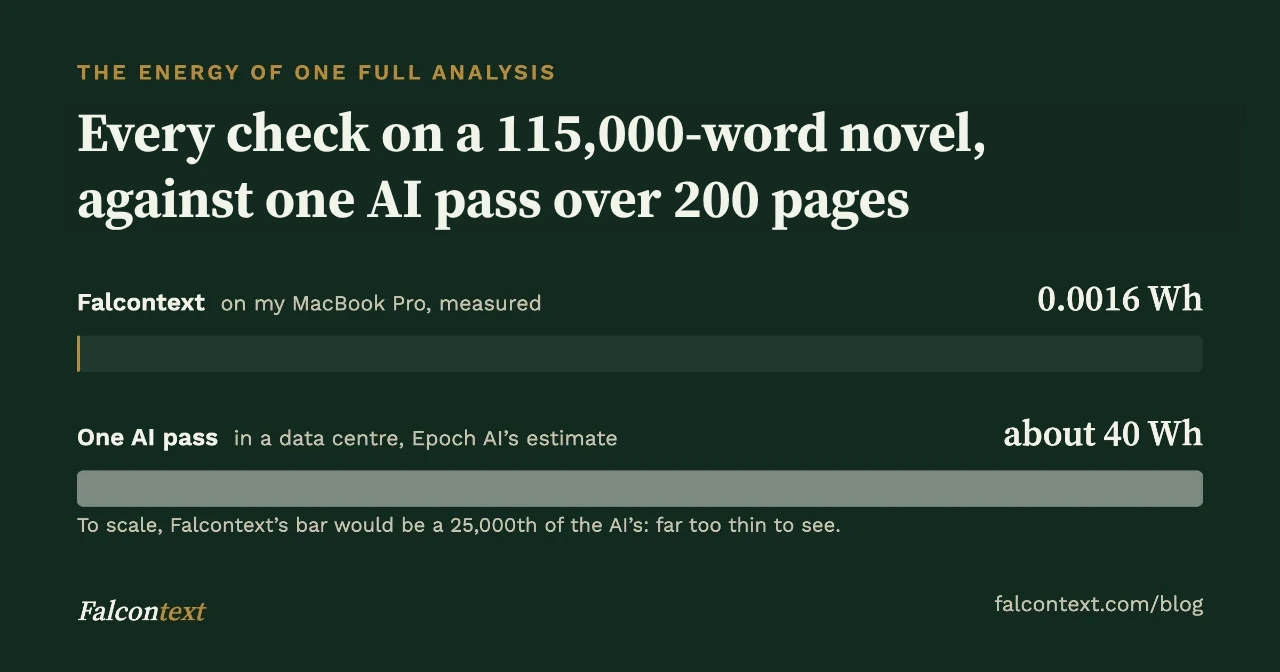
A short question to ChatGPT takes about 0.3 watt-hours. Hardly anything. But the more an AI has to read, the more energy it takes, and not just a little more. Having it read about 200 pages and give one short answer takes around 40 watt-hours. More than a hundred short questions.
And that’s the cheap version. One pass, one short answer. A full analysis, with every finding written out, takes more. And the “thinking” models? One study estimated almost 30 watt-hours for a single prompt of about 7,500 words.
(To be fair: these are estimates. AI companies publish a number for a typical short question at most, never for reading a whole book.)
And this isn’t a niche. In two surveys, between a quarter and almost half of authors said they use AI. And when people ask ChatGPT for help with writing, two out of three times it’s to change or critique text they already have.
And nobody checks a book just once.
AI tools can cache: check the same text again within minutes, and they can skip what they’ve just read. But change a word, and everything after that gets read again. Come back tomorrow, and it all gets read again. Revise for a month and that’s dozens of passes. Ten passes is 400 watt-hours. A thousand writers doing that: 400 kilowatt-hours. For straight quotes and a doubled “the the”.
So I measured it
So I measured mine, on my own novel, Tethered to Darkness.
| Falcontext | One AI pass | |
|---|---|---|
| What it read | Tethered to Darkness: 115,000 words | About 200 pages |
| What it did | All the checks it had then (38), over 14,000 things marked, good and bad | Answered one short question |
| Where | On my MacBook Pro | In a data centre |
| Time | 3.2 to 3.6 seconds the first time, 1.3 after that | (not published) |
| Energy | 0.0016 watt-hours (under 0.005 the first time) | Around 40 watt-hours |
| How I know | Measured with macOS’s own power meter, twice | An estimate (Epoch AI) |
More than 8,000 times as much, even for the slow first run. For every run after that, about 25,000 times. For one short answer.
Honestly, I was gobsmacked.
The difference is literally astronomical. For every pass, for every writer.
A doubled “the the” doesn’t need a data centre. It doesn’t need to “think”. It’s a rule, a few lines of code, and it gives the same answer every time.
So that’s what I’d rather see: tools making their own checks better, instead of sending every manuscript off to a data centre, again and again.
Falcontext’s checks run on the device you’re already writing on. It’s on anyway. 😉
“But AI could find so much more!”
Maybe.
So I tested it. The same 40 sentences for every tool, with 28 mistakes: sound-alikes and words typed twice.
Claude caught all 28. Google’s AI and Grammarly, which uses AI too, 27. ChatGPT 26. ProWritingAid 24.
Falcontext: 23. No AI at all, on your own device, and not a single false alarm. Word got 21, Pages 20, Google Docs 19.
And ChatGPT and Google’s AI both “corrected” a sentence that was already right. 🤣
So yes, AI finds a bit more. For a whole book, at thousands of times the energy.
And I don’t know what that AI has been trained on. Nor do I know what it would use my text for. And most importantly, I think Falcontext will in time be equal to what AI can find. I’ve been thinking about a way in which people can flag issues that weren’t found, so the lists of words I mentioned improve. That would make it Human Intelligence, instead of AI. And Human Learning, instead of Machine Learning.
That’s why it’s an AI-free writing tool
AI is definitely convenient for a lot of people, but for the use case of analyses like these it is simply not efficient. Or, dare I say it, intelligent. It’s not even like bringing a gun to a knife fight. It’s a whole army to do what Falcontext does with a butter knife.