Story structuresSeven shapes for a story.
The plot structures novelists use most, each from its own source.
Each page here says who made the structure, its beats in order and where they fall: for planning a book, or for looking at the one you wrote without a plan.
A story structure is a map of where a story usually turns. Some come with places: Syd Field and Blake Snyder put each turn on a page of a film script, which carries over to a novel as a share of the book. Others give the order of the parts and nothing more. Each page here says which, and gives numbers only where the source does.
With places for each beat
- Three-act structure Falcontext 6.0
Set-up, confrontation, resolution: a quarter, a half and a quarter, with a turn at the end of each of the first two acts and a Midpoint between them.
Syd Field, Screenplay (1979); the Midpoint from The Screenwriter’s Workbook (1984).
- Save the Cat Falcontext 6.0
Fifteen beats from Opening Image to Final Image, each with its page on a 110-page script: the most detailed of the structures here.
Blake Snyder, Save the Cat! (2005).
- The Hero’s Journey Falcontext 6.0
Twelve stages from the Ordinary World to the Return with the Elixir: Joseph Campbell’s monomyth, made into a writer’s tool by Christopher Vogler.
Christopher Vogler, The Writer’s Journey (1992), from Joseph Campbell, The Hero with a Thousand Faces (1949).
- The Story Circle Falcontext 6.0
You, Need, Go, Search, Find, Take, Return, Change: eight steps round a circle, the Hero’s Journey at its simplest.
Dan Harmon, “Story Structure” tutorials on Channel 101.
An order, without places
- Seven-point story structure
Hook, Plot Turn 1, Pinch 1, Midpoint, Pinch 2, Plot Turn 2, Resolution: planned from the end back to the start.
Dan Wells, talk at Life, the Universe, and Everything (February 2010).
- Freytag’s pyramid
Introduction, rise, climax, return or fall, catastrophe: the five-act play drawn as a pyramid, with the climax in the middle.
Gustav Freytag, Die Technik des Dramas (1863).
- Kishōtenketsu
Ki, shō, ten, ketsu: introduction, development, twist and conclusion, from Chinese four-line poems and Japanese four-panel comics.
Chinese poetry (qǐ chéng zhuǎn hé); Japanese yonkoma comics.
Side by side
| Structure | Source | Parts | Places |
|---|---|---|---|
| Three acts | Syd Field, 1979 | 3 acts, 2 plot points and a Midpoint | About 25%, 50% and 75% |
| Save the Cat | Blake Snyder, 2005 | 15 beats | A page for each, on 110 pages |
| The Hero’s Journey | Christopher Vogler, 1992 | 12 stages | Four placed: end of Act One, the middle, three-fourths, the climax |
| The Story Circle | Dan Harmon | 8 steps | Round a circle: quarters |
| Seven points | Dan Wells, 2010 | 7 points | Order only |
| Freytag’s pyramid | Gustav Freytag, 1863 | 5 parts, 3 moments | One part per act, roughly |
| Kishōtenketsu | Chinese poetry | 4 parts | Order only |
Which one?
They mostly agree. Three acts, Save the Cat, the Hero’s Journey and the Story Circle all turn at about a quarter of the way in, again in the middle, and again at about three quarters. Pick the one whose words help you think: Save the Cat if you like a detailed list, the Story Circle if you like it short, the Hero’s Journey for a story of leaving home and coming back, seven points if you know your ending first. Freytag’s pyramid suits a rise and a fall, and kishōtenketsu a story built round a turn rather than a fight.
Plan first, or write first
If you plan, a structure gives you places to write towards. If you write without a plan, it’s a way to look at the draft afterwards: find the scenes that already do each job, and see where they fall. Each page says how to do both.
A map, not a rule. Plenty of good books turn in other places. A beat far from where a structure puts it is something to look at, not a mistake.
In Falcontext 6.0 Out now
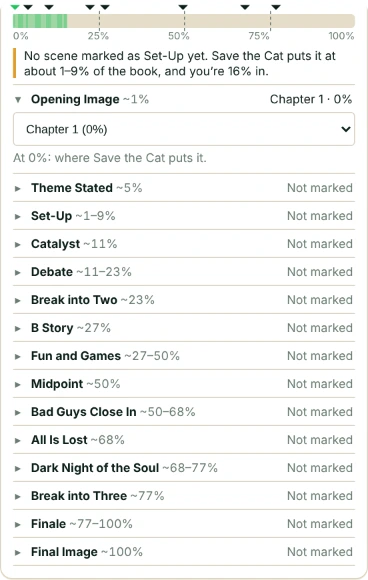
Falcontext 6.0 is out: in the browser extension, the desktop app and Falcontext Perch. It adds a Structure section to the Edit tab: pick Three acts, Save the Cat, the Hero’s Journey or the Story Circle, mark the chapter or scene that is each beat, and it says how far each one is from where the structure puts it, by word count. It names the beats you’ve gone past without marking one, too: “No scene marked as Dark Night of the Soul yet. Save the Cat puts it at about 68–77% of the book, and you’re 85% in.”
It measures against your book’s word count, or your word goal while the book is still shorter. No AI reads your writing, so Falcontext can’t tell which scene is a beat: you mark it. Seven points, Freytag’s pyramid and kishōtenketsu are explained here but not measured, because their sources give an order and no places.
Your writing is never sent anywhere, and no AI is used on your writing in any way.
For the rest of the first pass, the shape of the book, see the self-editing guide.
Your next chapter starts today.
Set a goal, open your draft and let the checks look over your shoulder.
Add to Chrome – it's freeOr get the desktop app or Perch, the web app.
Free forever plan · No sign-up · Pro from $1.99/month with a free trial