Story structures › Save the Cat
Story structure: Save the CatFifteen beats on 110 pages.
Blake Snyder’s beat sheet gives every beat a page. Read as shares of the story, those pages tell a novelist roughly where each beat falls: the Catalyst at about 11%, the Midpoint at half way, All Is Lost at about 68%.
Where it comes from
Blake Snyder was a Hollywood screenwriter, and Save the Cat! The Last Book on Screenwriting You’ll Ever Need (2005) is his book on how films are built. Its title is one of his rules: early on, the hero should do something, like saving a cat, that makes us like them and want them to win. The beat sheet is the book’s structure: 15 beats from Opening Image to Final Image, each on a page or a run of pages of a 110-page script.
For novelists, Jessica Brody adapted the method in Save the Cat! Writes a Novel (2018). The pages below are Snyder’s own, from the 2005 book.
The 15 beats, in order
A beat with one page is a moment; one with a run of pages is a stretch of the story. The share is the page as part of 110, which is how far through your novel it falls.
| Beat | Page (of 110) | Share | What happens |
|---|---|---|---|
| Opening Image | 1 | 1% | A snapshot of the hero and their world before the story changes them. |
| Theme Stated | 5 | 5% | Someone, often not the hero, says what the story is really about. The hero doesn’t see it yet. |
| Set-Up | 1–10 | 1–9% | The hero’s life, the people in it, and what’s missing from it. |
| Catalyst | 12 | 11% | The event that knocks that life over. |
| Debate | 12–25 | 11–23% | The hero hesitates: go, or stay? |
| Break into Two | 25 | 23% | The hero chooses, and steps into a new world. |
| B Story | 30 | 27% | A second story starts, often a love story or a friendship, that carries the theme. |
| Fun and Games | 30–55 | 27–50% | The promise of the premise: what the reader picked the book up for. |
| Midpoint | 55 | 50% | A false win or a false defeat, and the stakes go up. |
| Bad Guys Close In | 55–75 | 50–68% | Pressure from outside, doubt from inside. |
| All Is Lost | 75 | 68% | The lowest point. |
| Dark Night of the Soul | 75–85 | 68–77% | The hero takes in what they’ve lost. |
| Break into Three | 85 | 77% | The answer comes, often out of the B Story. |
| Finale | 85–110 | 77–100% | The hero puts what they’ve learnt to work. |
| Final Image | 110 | 100% | The opposite of the Opening Image: proof of the change. |
Three of them are the turns of three-act structure by other names: Break into Two ends Act 1, the Midpoint is in the middle, Break into Three starts Act 3. Snyder’s second act runs from about 23% to 77%, a little longer than Syd Field’s 25% to 75%.
Planning with it
The beat sheet is a list of questions. What does my hero’s life look like before? What knocks it over? What do they decide, and when? What’s the lowest point, and what gets them up again? Answer each one in a line or two, and you have an outline that already has a shape.
Start with the five turns (Catalyst, Break into Two, Midpoint, All Is Lost, Break into Three). The stretches between them, like Fun and Games and Bad Guys Close In, are what you write to get from one turn to the next.
Using it on a book written without a plan
After the draft, go through the beats and find the scene that does each job, if there is one. Then see where it falls. Your Catalyst at 25% may mean a long wait before anything happens; an All Is Lost at 90% leaves little room for the climb back. Some beats you won’t have, and that can be fine: a B Story or a Theme Stated isn’t in every good book.
Common misreadings
- Every beat must land on its page. They’re where the beats usually fall, not a contract. A few points either way is normal.
- “Save the cat” is a beat. It’s the book’s rule about making the hero likeable early, not one of the 15.
- Fun and Games means jokes. It means the premise, played out: the heist, the courtship, the magic school.
- The Midpoint must be a win. It can be a false defeat as well as a false victory. Either way, the stakes go up.
- It only works for films. The shares carry over to a novel, which is how Falcontext reads them.
In Falcontext 6.0 Out now
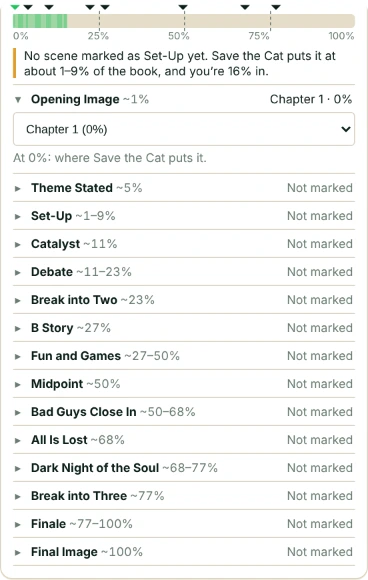
Falcontext 6.0 is out: in the browser extension, the desktop app and Falcontext Perch. It adds a Structure section to the Edit tab. Pick Save the Cat, mark the chapter or scene that is each beat, and Falcontext says how far each one is from where Save the Cat puts it. It also names the beats you’ve gone past without marking one:
No scene marked as Dark Night of the Soul yet. Save the Cat puts it at about 68–77% of the book, and you’re 85% in.
It measures by word count: against your book’s length, or against your word goal while the book is still shorter than that, so it works on a first draft that’s still growing. A beat that isn’t in your book can be marked as not in your book.
No AI reads your writing, so Falcontext can’t tell which scene is your Dark Night of the Soul. You mark it, and it does the measuring. Your writing is never sent anywhere, and no AI is used on your writing in any way.
Questions about Save the Cat.
What are the 15 beats of Save the Cat?
Opening Image, Theme Stated, Set-Up, Catalyst, Debate, Break into Two, B Story, Fun and Games, Midpoint, Bad Guys Close In, All Is Lost, Dark Night of the Soul, Break into Three, Finale and Final Image. Blake Snyder set them out in Save the Cat! (2005), each on a page of a 110-page script.
Where does each Save the Cat beat fall in a novel?
Read Snyder’s pages as shares of 110: the Catalyst at about 11%, Break into Two at about 23%, the Midpoint at 50%, All Is Lost at about 68%, Break into Three at about 77%, and the Finale from there to the end.
Other story structures
In Falcontext
Your next chapter starts today.
Set a goal, open your draft and let the checks look over your shoulder.
Add to Chrome – it's freeOr get the desktop app or Perch, the web app.
Free forever plan · No sign-up · Pro from $1.99/month with a free trial