Story structures › Three-act structure
Story structure: three actsBeginning, middle and end.
Three-act structure as Syd Field drew it: a quarter to set the story up, half to fight it out, a quarter to finish it. What each part does, where the turns fall in a novel, and how to use it with or without a plan.
Where it comes from
Syd Field was an American screenwriting teacher, and his first book, Screenplay: The Foundations of Screenwriting (1979), set out what he called the paradigm: a film script in three acts. On a script of 120 pages, Act 1, the set-up, runs about 30 pages. Act 2, the confrontation, about 60. Act 3, the resolution, about 30. At the end of each of the first two acts comes a plot point: an event that turns the story in a new direction.
The Midpoint came later, in his second book, The Screenwriter’s Workbook (1984): a turn around page 60 that splits the long second act in two.
Field never meant the page numbers as rules: what matters, he said, is the form of the screenplay, not the page a plot point lands on.
The parts, in order
Pages are on Field’s 120-page script; the share is how far through the story that is, which is how it carries over to a novel.
| Part | Page (of 120) | Share | What happens |
|---|---|---|---|
| Act 1: Set-up | 1–30 | 0–25% | Who, where, what’s at stake, and what sets the story going. |
| Plot Point 1 | about 20–30 | 17–25% | The first big turn: something happens that swings the story in a new direction and starts Act 2. |
| Act 2: Confrontation | 30–90 | 25–75% | The hero goes after what they need and meets obstacle after obstacle. |
| Midpoint | about 60 | 50% | Added in Field’s second book: an event that splits Act 2 into two halves of about 30 pages. |
| Plot Point 2 | about 90 | 75% | The second big turn, which starts the ending. |
| Act 3: Resolution | 90–120 | 75–100% | The story plays out and is resolved. |
In a 90,000-word novel, that puts the end of Act 1 around 22,500 words, the Midpoint around 45,000 and the end of Act 2 around 67,500.
Planning with it
Before you start, know three things: what turns the story at the end of Act 1, what changes in the middle, and what starts the ending. They don’t need to be detailed. They’re places to write towards, and they tell you when the set-up has gone on long enough.
Then fill in each act: in Act 1, what the reader needs before the first turn; in Act 2, what stands in the way, and how it gets worse after the Midpoint; in Act 3, how it ends.
Using it on a book written without a plan
Three acts also work after the fact. Write the draft, then look for the turns that are already there: the scene where the story can’t go back the way it was (Plot Point 1), the one where everything shifts in the middle, the one that starts the ending. Then see how far through the book each one is.
If your first turn comes at 40%, ask what the reader is waiting for: maybe the set-up holds things they don’t need yet. If nothing changes between 30% and 75%, that’s the long middle that sags, and a turn near the half way mark may be what it’s missing. A turn in a different place isn’t wrong. It’s something to look at.
Common misreadings
- Three acts of the same length. No: Act 2 is as long as the other two together.
- The page numbers are rules. They’re where the turns usually fall, on a script of a usual length. Field’s point was the shape.
- A plot point is the biggest event. It’s a turn: what sends the story somewhere new. It can be quiet, a decision or a phone call.
- The middle is where nothing happens. It’s half the book. The Midpoint is there to give it a shape of its own.
Save the Cat’s 15 beats fit inside the same three acts: Save the Cat puts the start of Act 2 at 23% and the start of Act 3 at 77%.
In Falcontext 6.0 Out now
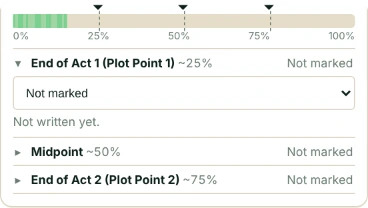
Falcontext 6.0 is out: in the browser extension, the desktop app and Falcontext Perch. It adds a Structure section to the Edit tab. Pick Three acts, mark the chapter or scene that is each beat, and Falcontext says how far each one is from where Three acts puts it. It also names the beats you’ve gone past without marking one:
No scene marked as Midpoint yet. Three acts puts it at about 50% of the book, and you’re 85% in.
It measures by word count: against your book’s length, or against your word goal while the book is still shorter than that, so it works on a first draft that’s still growing. A beat that isn’t in your book can be marked as not in your book.
No AI reads your writing, so Falcontext can’t tell which scene is your Midpoint. You mark it, and it does the measuring. For three acts, the beats are the ends of Acts 1 and 2 and the Midpoint, at 25%, 75% and 50%. Your writing is never sent anywhere, and no AI is used on your writing in any way.
Questions about three-act structure.
What is three-act structure?
A story in three parts: a set-up, a confrontation and a resolution. Syd Field set it out for screenwriters in Screenplay (1979): on a 120-page script, Act 1 runs to about page 30, Act 2 to about page 90 and Act 3 to the end, so about a quarter, a half and a quarter. A turn, the plot point, ends each of the first two acts.
Where does the midpoint go in three-act structure?
In the middle: around page 60 of Field’s 120-page script, so about half way through the book. Field added the Midpoint in The Screenwriter’s Workbook (1984), to split the long second act into two halves.
Other story structures
In Falcontext
Your next chapter starts today.
Set a goal, open your draft and let the checks look over your shoulder.
Add to Chrome – it's freeOr get the desktop app or Perch, the web app.
Free forever plan · No sign-up · Pro from $1.99/month with a free trial