Story structures › Freytag’s pyramid
Story structure: Freytag’s pyramidUp to the top, then down.
Gustav Freytag drew the five-act play as a pyramid: it rises to a climax in the middle and falls to the end. The oldest structure here, and the one whose climax isn’t where most people think.
Where it comes from
Gustav Freytag was a German novelist. His book on how plays are built, Die Technik des Dramas, was written in 1863, and was translated into English by Elias J. MacEwan in 1894 as Technique of the Drama. He took his examples from Greek tragedy, Shakespeare and the German stage: Lessing, Goethe, Schiller.
His picture of a play: it rises from the introduction to a climax, then falls to the catastrophe. Drawn as lines, he wrote, that’s a pyramid.
The five parts, in order
Five parts, with three moments between them that join them and set them apart. In the plays of his day, Freytag says, each act generally holds one part, though never exactly. He gives no pages or proportions.
| Part | In a five-act play | What happens |
|---|---|---|
| 1. Introduction | The first act | The situation and the people, before the action starts. |
| The exciting moment | What sets the action going. Freytag says every play needs it. | |
| 2. Rise | The second act | The action builds. |
| 3. Climax | The third act | The peak, where the action turns. |
| The tragic moment | What starts the counter-action, and the fall. | |
| 4. Return or fall | The fourth act | Things turn against the hero. |
| The moment of last suspense | One last hope before the end. | |
| 5. Catastrophe | The fifth act | The end: in a tragedy, the hero’s downfall. |
The first of the three moments is much like what screenwriters now call the inciting incident. Freytag thought the other two good to have, but not essential.
Using it for a novel
Freytag wrote about tragedy: a hero who rises and falls. For a novel, the pyramid’s use is its shape. Where’s the peak of your story, the point where it turns? What rises to it, and what falls from it? A tragedy, or any story of a rise and a fall, fits the pyramid best.
On a draft, mark the peak and see how much of the book climbs to it and how much comes after. A long fall can be the point (the downfall is the story), or it can be a book that has finished before it ends.
Common misreadings
- The climax is the big final battle. Not in Freytag: his climax is the top of the pyramid, in the middle, where the action turns. What comes near the end is the catastrophe.
- Catastrophe means disaster. It’s the last part, the end. In the tragedies he wrote about, that’s the hero’s downfall.
- “Falling action” means the story slows down. The return, or fall, is the hero’s fortunes turning against them, and the moment of last suspense still comes in it.
- The five parts are five equal acts. Freytag says himself the acts never match the parts exactly.
The three-act structure most novelists use today puts its biggest turns near the ends of the first and second acts, not at a single peak in the middle.
In Falcontext
Falcontext 6.0 (in the browser extension, the desktop app and Falcontext Perch) measures your book against three acts, Save the Cat, the Hero’s Journey and the Story Circle: you mark the scene that is each beat, and it says how far that is from where the structure puts it. Freytag’s pyramid is explained here but not measured, because its source gives an order and no places: there’s nothing honest to measure against.
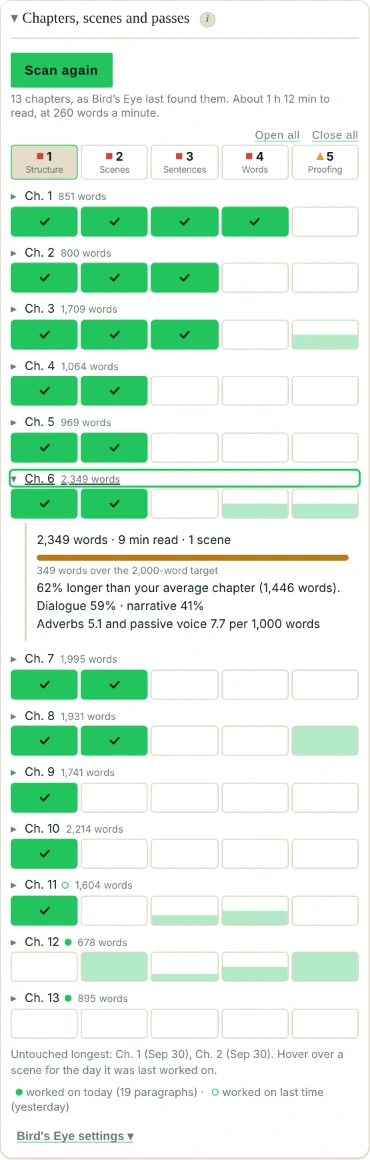
What you can use today: Bird’s Eye shows where each chapter and scene starts and how long it is, so you can see where your turns fall yourself. Your writing is never sent anywhere, and no AI is used on your writing in any way.
Questions about Freytag’s pyramid.
What are the five parts of Freytag’s pyramid?
In Freytag’s own words (in the English translation of 1894): introduction, rise, climax, return or fall, and catastrophe. Between them come three moments: the exciting moment, the tragic moment and the moment of last suspense.
Where is the climax in Freytag’s pyramid?
In the middle: it’s the top of the pyramid, the third of the five parts, where the action turns and starts to fall. In the five-act plays Freytag wrote about, the third act usually held it.
Other story structures
In Falcontext
Your next chapter starts today.
Set a goal, open your draft and let the checks look over your shoulder.
Add to Chrome – it's freeOr get the desktop app or Perch, the web app.
Free forever plan · No sign-up · Pro from $1.99/month with a free trial