Story structures › Kishōtenketsu
Story structure: kishōtenketsuFour parts, one turn.
Kishōtenketsu builds a story round a turn instead of a fight: an introduction, a development, a twist, and a conclusion that brings them together. It comes from Chinese poetry, and Japanese four-panel comics use it panel by panel.
Where it comes from
The four parts come from Chinese poetry, where they’re called qǐ chéng zhuǎn hé: the way to build a four-line poem. The scholar Fan Heng (1272–1330) described them as four ways of writing poetry. In Japanese they became kishōtenketsu, and in Korean giseungjeongyeol.
In Japan the form is used for essays and arguments as well as stories, and most visibly in yonkoma, comic strips of four panels, where each panel is one part.
The four parts, in order
The sources give the order and what each part does, but no proportions, so there are none here. In a four-panel comic, each part is a quarter; in a novel, nobody says.
| Part | Means | What happens |
|---|---|---|
| Ki (起) | Introduction | The characters, the place, what the reader needs to know. |
| Shō (承) | Development | It goes on, building towards the turn, without big changes yet. |
| Ten (転) | Twist | An unexpected turn: the heart of the story. |
| Ketsu (結) | Conclusion | The story is wrapped up. |
Using it for a novel
Most Western structures are driven by a conflict: someone wants something, and someone or something stands in the way. Kishōtenketsu is driven by a turn instead. The first two parts lay something out; the third brings in something unexpected; the fourth wraps it up.
It suits a quiet novel, a literary one, a story of a life or a place. It also works at a smaller size: a chapter or a scene can be built as four parts, with its turn in the third. And in a book written without a plan, it’s a way to look at a story that doesn’t seem to fit three acts: where’s the turn, and what does the ending make of it?
Common misreadings
- A story without conflict. Conflict isn’t what holds it up, but many stories told this way have conflict in them.
- The twist is a plot twist. It’s a turn, something unexpected. It doesn’t have to be a surprise that undoes everything.
- Four equal parts. In a four-panel comic, yes. In longer stories, the sources don’t say.
If your book does have its turn in the middle, three acts or Save the Cat give it a place to land.
In Falcontext
Falcontext 6.0 (in the browser extension, the desktop app and Falcontext Perch) measures your book against three acts, Save the Cat, the Hero’s Journey and the Story Circle: you mark the scene that is each beat, and it says how far that is from where the structure puts it. Kishōtenketsu is explained here but not measured, because its source gives an order and no places: there’s nothing honest to measure against.
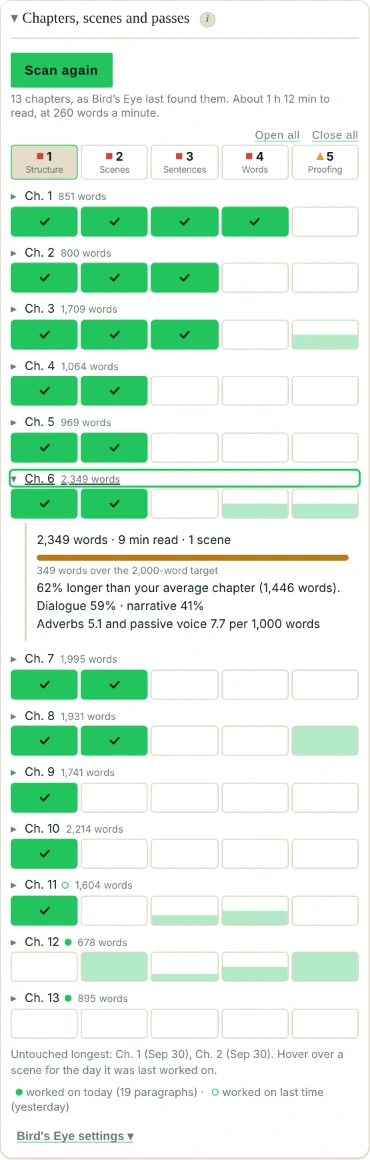
What you can use today: Bird’s Eye shows where each chapter and scene starts and how long it is, so you can see where your turns fall yourself. Your writing is never sent anywhere, and no AI is used on your writing in any way.
Questions about kishōtenketsu.
What is kishōtenketsu?
A structure in four parts: ki (introduction), shō (development), ten (twist) and ketsu (conclusion). It comes from Chinese poetry, where it’s called qǐ chéng zhuǎn hé, and is used in Japanese four-panel comics (yonkoma), one part per panel.
Does kishōtenketsu have no conflict?
It’s often called a structure without conflict. More exactly, conflict isn’t what it’s built on: the turn is. Stories told in it can and often do have conflict as well.
Other story structures
In Falcontext
Your next chapter starts today.
Set a goal, open your draft and let the checks look over your shoulder.
Add to Chrome – it's freeOr get the desktop app or Perch, the web app.
Free forever plan · No sign-up · Pro from $1.99/month with a free trial