Story structures › The Hero’s Journey
Story structure: the Hero’s JourneyThere and back again.
Joseph Campbell found one journey under the world’s myths; Christopher Vogler turned it into 12 stages for writers. What each stage does, where Vogler says the big ones fall, and why he gives no page numbers.
Where it comes from
In The Hero with a Thousand Faces (1949), the mythologist Joseph Campbell described one pattern he found in myths from around the world, the monomyth: a hero leaves the everyday world, wins through in a place of wonder, and comes back changed. He described it in 17 stages, in three parts: departure, initiation and return.
Christopher Vogler, a Hollywood film producer and writer, boiled Campbell down for writers: first as a seven-page studio memo, A Practical Guide to The Hero with a Thousand Faces, then as a book, The Writer’s Journey (1992). His version has 12 stages, and it’s the one most writers mean by the Hero’s Journey.
The 12 stages, in order
Vogler gives no page numbers, and this page doesn’t make any up. His own handout says where four of the stages fall (quoted below); the rest come between them, in order.
| Stage | Act | Where Vogler puts it | What happens |
|---|---|---|---|
| The Ordinary World | Act One | The start | The hero at home, before the adventure. |
| Call to Adventure | Act One | A problem or a challenge arrives. | |
| Refusal of the Call | Act One | The hero holds back, afraid. | |
| Meeting with the Mentor | Act One | Someone gives them advice, a gift or courage. | |
| Crossing the First Threshold | Ends Act One | “At the end of Act One” | The hero commits, and leaves the ordinary world. |
| Tests, Allies, Enemies | Act Two | The rules of the new world; who’s a friend, who isn’t. | |
| Approach to the Inmost Cave | Act Two | Getting close to the most dangerous place. | |
| The Ordeal | Act Two | “Near the middle of the story” | The hero faces death, or their greatest fear. |
| Reward | Act Two | They take hold of what they came for. | |
| The Road Back | Act Three | “About three-fourths of the way through” | The hero sets out for home, often chased. |
| Resurrection | Act Three | “At the climax” | One last test, the hardest. |
| Return with the Elixir | Act Three | The end | Home again, with something that helps others. |
So the Hero’s Journey lines up with three acts: the threshold ends the first act, the Ordeal is the middle, and the Road Back, three quarters of the way through, starts the last.
Planning with it
Start with the two worlds: the ordinary one your hero leaves and the special one they go into. A thriller’s special world can be a city the hero has always lived in, seen from the inside of a crime. Then find your Ordeal, the moment in the middle where the hero faces what they fear most, and your Resurrection, the final test that proves they’ve changed. The other stages are how you get from one to the next.
The mentor, the threshold guardian and the rest are jobs, not people: one character can do two of them, and a mentor can be a dead parent’s letter.
Using it on a book written without a plan
After the draft, look for the threshold: the scene after which your hero can’t go home the way they were. Is it near the end of the first quarter? Then the Ordeal: is there one, and is it near the middle? A book that runs out of steam in the middle often has its Ordeal too late, or not at all. And look for the return: a hero who wins and simply stops leaves the reader without the last change.
Common misreadings
- All 12 stages, in this order, every time. It’s a map of what often happens, not a checklist. Many good books skip a stage or move one.
- The hero is a warrior. A hero is whoever goes on the journey: a widow learning to live alone takes one too.
- The return is going home. It can be, but what matters is what the hero brings back, the elixir: a lesson, a cure, a changed heart.
- The Ordeal is the climax. It’s the crisis in the middle. The climax is the Resurrection, near the end.
For a shorter version of the same journey, see Dan Harmon’s Story Circle: eight steps, drawn round a circle, that he based on Campbell.
In Falcontext 6.0 Out now
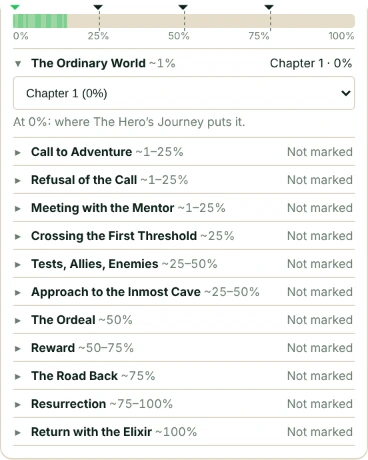
Falcontext 6.0 is out: in the browser extension, the desktop app and Falcontext Perch. It adds a Structure section to the Edit tab. Pick the Hero’s Journey, mark the chapter or scene that is each beat, and Falcontext says how far each one is from where the Hero’s Journey puts it. It also names the beats you’ve gone past without marking one:
No scene marked as The Ordeal yet. The Hero’s Journey puts it at about 50% of the book, and you’re 85% in.
It measures by word count: against your book’s length, or against your word goal while the book is still shorter than that, so it works on a first draft that’s still growing. A beat that isn’t in your book can be marked as not in your book.
No AI reads your writing, so Falcontext can’t tell which scene is your Ordeal. You mark it, and it does the measuring. Vogler gives no pages, so Falcontext places each stage within its act, using Syd Field’s act lengths: Act One the first quarter, Act Two the middle half, Act Three the last quarter. The threshold is at 25%, the Ordeal at 50% and the Road Back at 75%, as Vogler’s own handout has them. Your writing is never sent anywhere, and no AI is used on your writing in any way.
Questions about the Hero’s Journey.
What are the 12 stages of the Hero’s Journey?
In Christopher Vogler’s version: the Ordinary World, the Call to Adventure, Refusal of the Call, Meeting with the Mentor, Crossing the First Threshold, Tests, Allies, Enemies, Approach to the Inmost Cave, the Ordeal, Reward, the Road Back, Resurrection, and Return with the Elixir.
Where does each stage of the Hero’s Journey fall?
Vogler gives no page numbers. His own handout places four stages: Crossing the First Threshold at the end of Act One, the Ordeal near the middle of the story, the Road Back about three-fourths of the way through, and the Resurrection at the climax. The others fall between them, in order.
Other story structures
In Falcontext
Your next chapter starts today.
Set a goal, open your draft and let the checks look over your shoulder.
Add to Chrome – it's freeOr get the desktop app or Perch, the web app.
Free forever plan · No sign-up · Pro from $1.99/month with a free trial