Story structures › The Story Circle
Story structure: the Story CircleDown, and back up again.
Dan Harmon’s eight steps, drawn round a circle: a character leaves where they’re comfortable, gets what they wanted, pays for it and comes back changed. Where each step sits on the circle, and what that means for a novel.
Where it comes from
Dan Harmon created the sitcom Community and co-created Rick and Morty. With Rob Schrab he founded Channel 101, where people make and show short pilots, and on its wiki he wrote a series of tutorials on story structure. The first sets out the circle; a later one goes through each step. The circle is his reworking of Joseph Campbell’s Hero’s Journey, and he quotes Campbell and Vogler as he goes.
His instructions: draw a circle, and divide it with a line down and a line across. Starting at 12 o’clock and going clockwise, number the four places where the lines meet the circle 1, 3, 5 and 7, and the quarters between them 2, 4, 6 and 8. The top half is the ordinary world, the bottom half the special world the story goes into.
The eight steps, in order
Harmon gives no page numbers. The circle itself does say where each step sits, though, so the share column reads it as the length of the story: Go a quarter of the way round, Find at the bottom, Return at three quarters.
| Step | On the circle | Share | What happens |
|---|---|---|---|
| 1. You | Top (12 o’clock) | 0% | A character in their comfort zone. |
| 2. Need | First quarter | 0–25% | But they want something. |
| 3. Go | 3 o’clock | 25% | They go into an unfamiliar situation. |
| 4. Search | Second quarter | 25–50% | They adapt to it. |
| 5. Find | Bottom (6 o’clock) | 50% | They get what they wanted. |
| 6. Take | Third quarter | 50–75% | They pay a heavy price for it. |
| 7. Return | 9 o’clock | 75% | They go back to the familiar. |
| 8. Change | Last quarter | 75–100% | Having changed. |
Harmon says himself that Find, at the bottom of the circle, is what Syd Field calls the Midpoint. Go and Return fall where three acts put the ends of Acts 1 and 2.
Planning with it
The circle is small enough to plan a whole book with, or a single chapter, or a scene. Start with Need: what does your character want, and what’s missing that they don’t know about? Then Find (what they get) and Take (what it costs). If you know those three, the rest tends to follow.
The circle also works in layers. A novel can go round it once, and each act, chapter or subplot can go round its own smaller circle.
Using it on a book written without a plan
After the draft, find the moment your character crosses into the unfamiliar (Go) and the moment they get what they were after (Find). If Go comes late, the top of the circle, the ordinary world, may be taking too long. If they get what they wanted at the very end, there’s no Take and no Return: the book may stop where the story should turn for home.
Common misreadings
- Find is the happy ending. It’s the middle. Getting what you wanted is half way, and it comes at a price.
- Take means taking something. In Harmon’s words, the character pays a heavy price for what they found.
- Return means nothing has changed. They come back to the familiar so we can see how they have changed.
- It’s only for sitcoms. Harmon says it’s in films, anecdotes, dreams and fairy tales.
In Falcontext 6.0 Out now
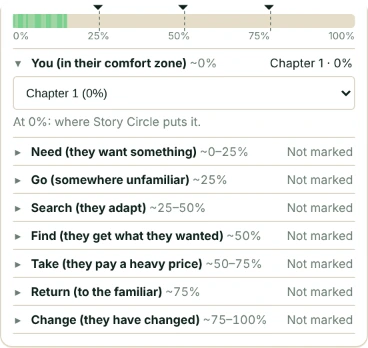
Falcontext 6.0 is out: in the browser extension, the desktop app and Falcontext Perch. It adds a Structure section to the Edit tab. Pick the Story Circle, mark the chapter or scene that is each beat, and Falcontext says how far each one is from where the Story Circle puts it. It also names the beats you’ve gone past without marking one:
No scene marked as Find (they get what they wanted) yet. Story Circle puts it at about 50% of the book, and you’re 85% in.
It measures by word count: against your book’s length, or against your word goal while the book is still shorter than that, so it works on a first draft that’s still growing. A beat that isn’t in your book can be marked as not in your book.
No AI reads your writing, so Falcontext can’t tell which scene is your Find. You mark it, and it does the measuring. For the Story Circle, the steps on the lines are points (You at the start, Go at 25%, Find at 50%, Return at 75%) and the others are the quarters between. Your writing is never sent anywhere, and no AI is used on your writing in any way.
Questions about the Story Circle.
What are the 8 steps of Dan Harmon’s Story Circle?
You, Need, Go, Search, Find, Take, Return and Change: a character is in a zone of comfort, but they want something; they go into an unfamiliar situation, adapt to it, get what they wanted, pay a heavy price for it, return to the familiar, and have changed.
Where does each step of the Story Circle fall in a story?
Harmon gives no pages; he draws the steps round a circle. Read the circle as the length of the story and Go comes a quarter of the way in, Find half way, and Return at three quarters, with the other steps in the quarters between.
Other story structures
In Falcontext
Your next chapter starts today.
Set a goal, open your draft and let the checks look over your shoulder.
Add to Chrome – it's freeOr get the desktop app or Perch, the web app.
Free forever plan · No sign-up · Pro from $1.99/month with a free trial