Prose checks › Filler words
Filler words vs filter wordsFiller words aren’t filter words.
One letter apart, and writers mix them up all the time. Filter words put a narrator between the reader and the scene. Filler words just take up room. Here’s the difference, and how Falcontext finds both.

The short version
| Filter words | Filler words | |
|---|---|---|
| What they are | Verbs of seeing, feeling and knowing: felt, saw, heard, noticed, realised, knew | Words that add little or nothing: just, really, very, actually, basically, quite |
| The problem | They put the narrator between the reader and the scene | They pad a sentence and soften what it says |
| The fix | Cut the filter, keep what’s perceived | Cut them, or say it stronger |
| Falcontext’s check | Filter words (free) | Adverbs (free) and Your crutch words (Pro) |
Filter words, in one example
The filter is the narrator saying “she noticed”. Take it out and the reader notices instead. More on filter words.
Filler words, in one example
Nothing was lost. The sentence got shorter and, if anything, stronger.
How Falcontext finds filler words
Not with one check, but two:
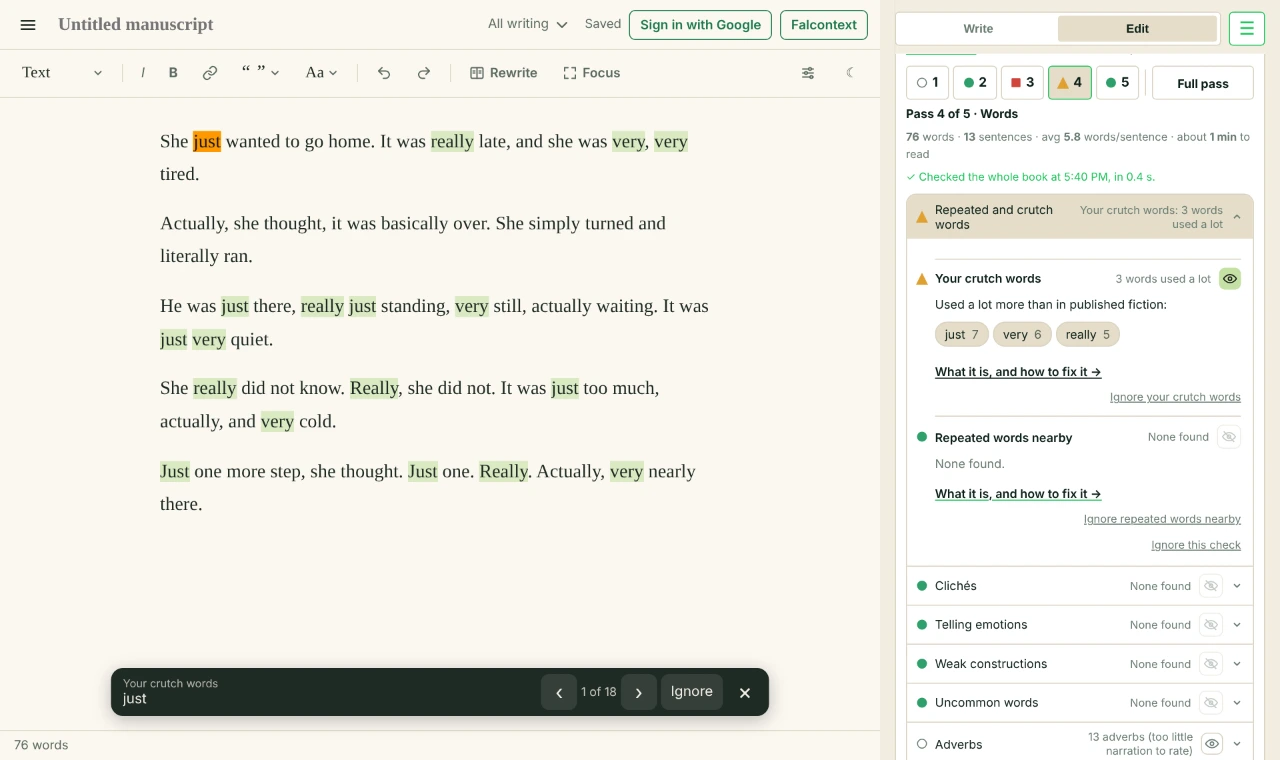
- Adverbs (free) flags the -ly fillers: really, actually, basically, simply, literally.
- Your crutch words (Pro) flags just, very, quite, rather, really and more. But only once you use one at least twice as often as published fiction, and at least five times.
So one “just” is never flagged. A “just” on every page is.
Should you cut every one?
No. In dialogue, people talk in fillers, and both checks leave dialogue alone.
And in narration, a “just” can carry a voice. The point is to notice them. What you do with them is up to you.
Guidelines, not rules. Your narrator can say “just” too. Just not forty times.
Filter words have a check of their own in the fourth pass of the self-editing guide, words, next to adverbs and clichés.
Filler or filter: which one sneaks into your drafts?
Questions about filler words.
What’s the difference between filler words and filter words?
Filter words are verbs of seeing, feeling and knowing (felt, saw, heard, realised) that put a narrator between the reader and the scene. Filler words (just, really, very, actually) add little or nothing to a sentence. Different words, different fixes.
Does Falcontext have a filler word checker?
Two checks find them. Adverbs, free, flags the -ly ones: really, actually, basically, simply, literally. Your crutch words, in Pro, flags just, very, quite, rather and others once you use them at least twice as often as published fiction.
Is “just” a filler word?
Often, yes: “She just wanted to go home” works without it. But published novels use “just” plenty, which is why Falcontext only flags it when you use it far more than they do.
Related checks
In Falcontext
Your next chapter starts today.
Set a goal, open your draft and let the checks look over your shoulder.
Add to Chrome – it's freeOr get the desktop app or Perch, the web app.
Free forever plan · No sign-up · Pro from $1.99/month with a free trial