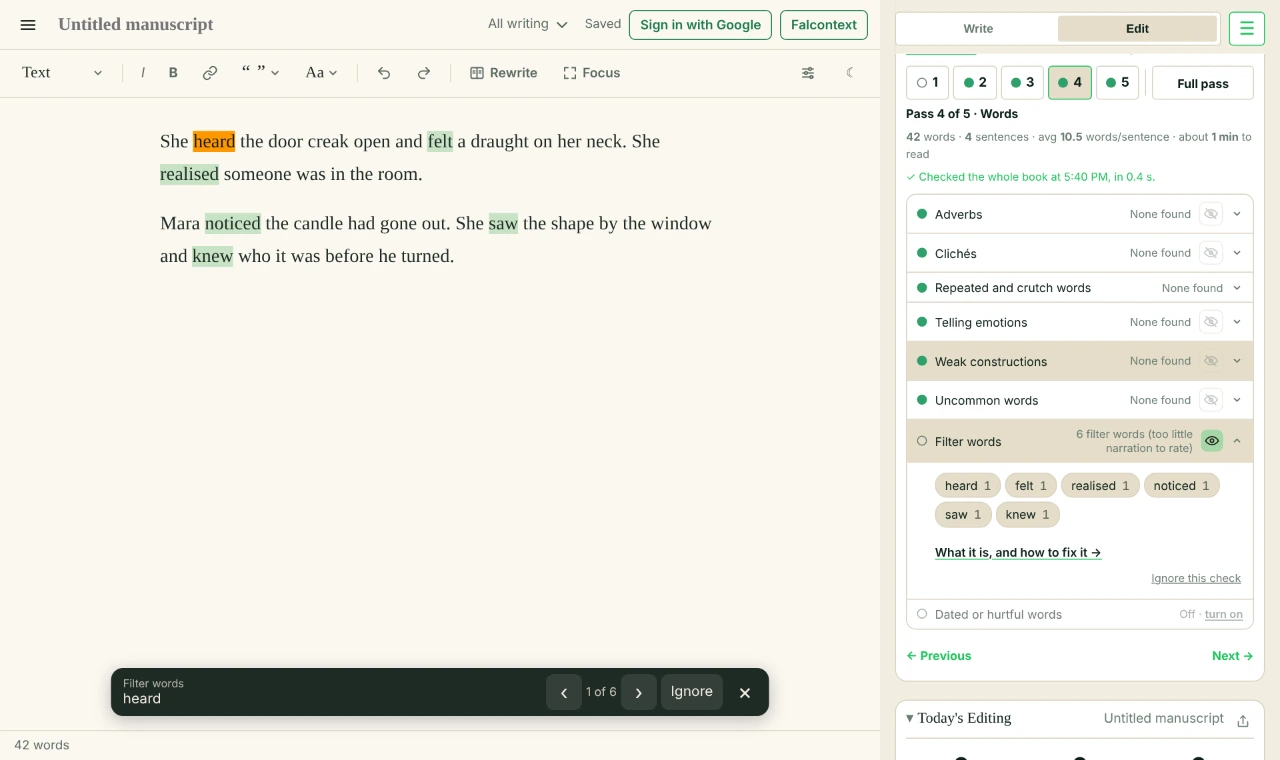
Prose check: filter wordsFelt, saw, knew: the words between your reader and the scene.
“She heard the door creak.” Or just: “The door creaked.” The second one puts your reader in the room. Falcontext finds filter words like that in your narration, and tells you whether you use more than published novels do.
Paste a chapter, or a few pages. Every filter word in the narration is marked, with the light Falcontext would give it. It’s checked right here, in your browser: your writing is never sent anywhere, and no AI is used on your writing in any way.
What are filter words?
The seeing, feeling and thinking words: felt, saw, heard, noticed, realised, wondered, watched, thought, knew, smelled, tasted, decided, understood, recognised, seemed and appeared.
They tell your reader that the character noticed something. Instead of letting the reader notice it.
BeforeShe heard the door creak open and felt a draught on her neck. She realised someone was in the room.
AfterThe door creaked open. A draught touched her neck. Someone was in the room.
Same scene. One of them has a narrator standing in the way.
So I should cut them all?
No.
Sometimes the noticing is the point. “She saw him before he saw her” needs that “saw”. And a more distant narrator uses them on purpose.
So Falcontext doesn’t ask for zero. It compares you with published fiction.
How many is normal?
More than you’d think. In English fiction published 2000–2019, they come up about 14 times per 1,000 words.
Across the 38 published books I measured, the middle one had 12.0 per 1,000 words. Three in four had 14.2 or fewer. The most had 21.0.
Guidelines, not rules. This check is here to make you aware of how often you filter, not to take every “saw” out of your book. Ignore it at your leisure.
Finds
The sixteen filter verbs in every form (feel, feels, felt, feeling…), US and UK spellings alike. Only the narration: in dialogue, “I saw him” is just how people talk.
Traffic light
Up to 14 per 1,000 words
Up to 18
More than 18
The ones you use most come first, with their counts.
The eye marks every one in your own text, so you can work down the page.
Meant it? Ignore it, just there or everywhere, and the light updates.
How to fix one
Cut the filter, keep what’s perceived. “She saw the ship come in” → “The ship came in.”
Put the feeling in the body. “He felt cold” → “His fingers wouldn’t close.”
Or keep it. A character who realises something too late needs that “realised”.
Falcontext points them out. You decide. It’s your book.
Filter words come up in the words pass, the fourth of five: change the ones that weaken the sentence, keep the ones you love.
Which filter word sneaks into your drafts the most?
Not to be confused with filler words (just, really, very). Different words, different fix.
Questions about filter words.
What is a filter word?
A verb of perceiving or thinking, such as felt, saw, heard, noticed, realised or knew, that tells the reader a character perceived something instead of showing the thing itself. “She heard the door creak” filters; “The door creaked” doesn’t.
Is “thought” a filter word?
Often, yes: “She thought it was too late” can usually become “It was too late.” Falcontext counts thought, think and their forms, but only in the narration, never in dialogue.
How many filter words are too many?
Published fiction from 2000–2019 averages about 14 per 1,000 words. Falcontext’s light is green up to 14 per 1,000 words of narration, orange up to 18 and red above that.
Is the filter word checker free?
Yes, with no word limit: run it on the whole book as often as you like, no sign-up.