Prose checks › Telling emotions Pro
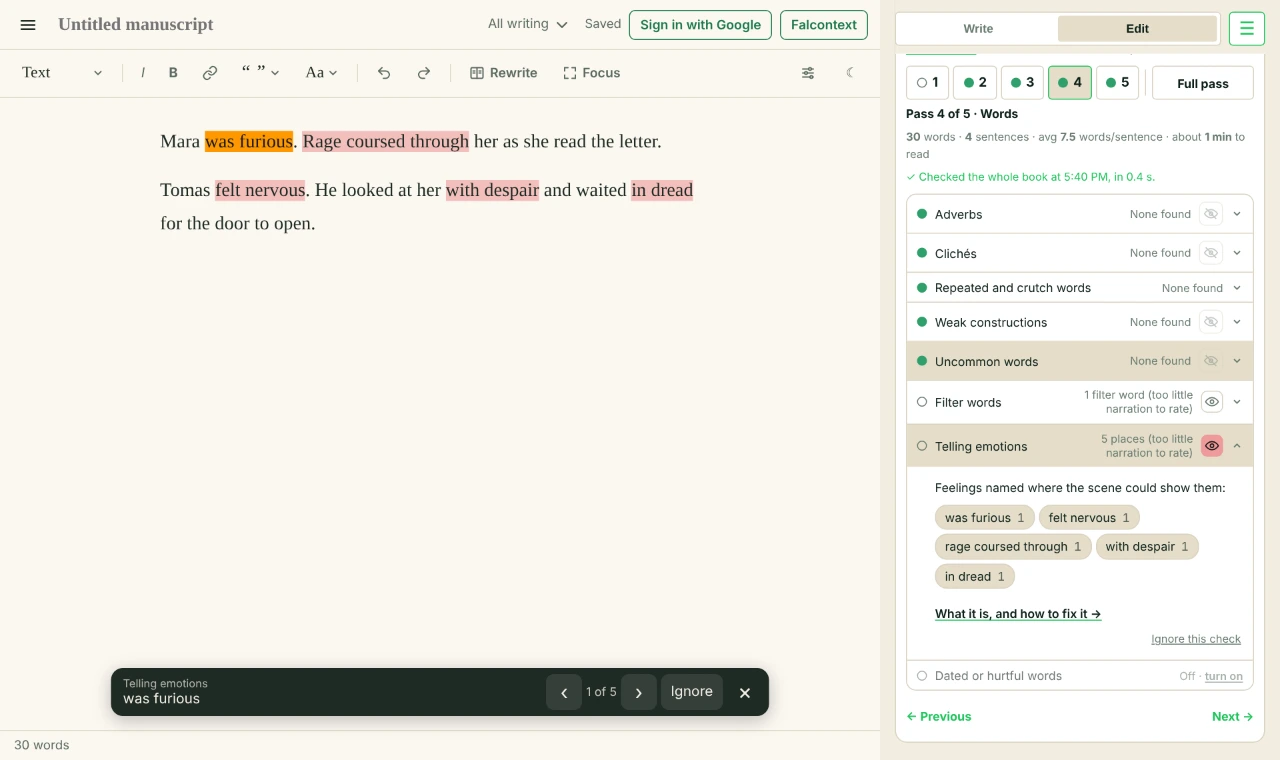
Prose check: telling emotionsShe was angry. Show me.
“Show, don’t tell.” The oldest advice in fiction, and the hardest to see in your own pages. Falcontext finds where your narration names a feeling outright. Then you decide where the scene should show it.

What is telling an emotion?
Naming the feeling, instead of letting the reader feel it. It comes in three shapes:
- Was, felt or seemed, plus a feeling: she was furious, he felt nervous, they seemed relieved.
- A feeling that does something: fear gripped him, relief washed over her, rage coursed through him.
- With or in a feeling: she looked at him with despair, he waited in dread.
Show, don’t tell: is telling always wrong?
No. A quick “she was tired” gets your reader past a moment that doesn’t matter.
Telling hurts where the feeling is the scene.
And some phrases only look like feelings. “I’m afraid you’re wrong” and “guilty of” aren’t flagged.
How many is normal?
Very few. Across the 38 published books I measured, the middle one named a feeling about 0.4 times per 1,000 words. The most, 1.7 times.
Where these numbers come from.
How Falcontext checks show, don’t tell
Guidelines, not rules. Telling isn’t wrong. The check makes you aware of where you do it, so you can choose where to show instead.
- Finds
- Feelings named outright in the narration (angry, afraid, relieved, furious, heartbroken and more), each one marked in your text. Dialogue isn’t counted.
- Traffic light
- Up to 0.5 per 1,000 words
- Up to 1.5
- More than 1.5
Two more Pro checks help with showing: The five senses (how much your writing draws on sound, smell, touch and taste, not just sight) and Stage directions (nods, shrugs and sighs standing in for feeling).
Telling emotions is part of the guide’s fourth pass, words, with Browne and King’s reminder that in scenes, events are seen as they happen.
Where do you find it hardest to show instead of tell?
Questions about telling emotions.
How do I find telling in my writing?
Look for feelings named outright: was angry, felt nervous, fear gripped him, with relief. Falcontext finds these in your narration and marks each one, so you can decide where the scene should show the feeling instead.
Does the check flag “I’m afraid” in dialogue?
No. Dialogue isn’t counted, and in the narration “afraid that” (sorry to say) and “guilty of” aren’t flagged either.
Is the show-don’t-tell checker free?
It’s a Pro check, and the free trial lets you try it on your own book. On the free plan it still shows green, orange or red, so you know whether there’s anything to find.
Related checks
In Falcontext
Your next chapter starts today.
Set a goal, open your draft and let the checks look over your shoulder.
Add to Chrome – it's freeOr get the desktop app or Perch, the web app.
Free forever plan · No sign-up · Pro from $1.99/month with a free trial