Prose checks › One word or two Pro
Prose check: one word or twoEvery day, or everyday?
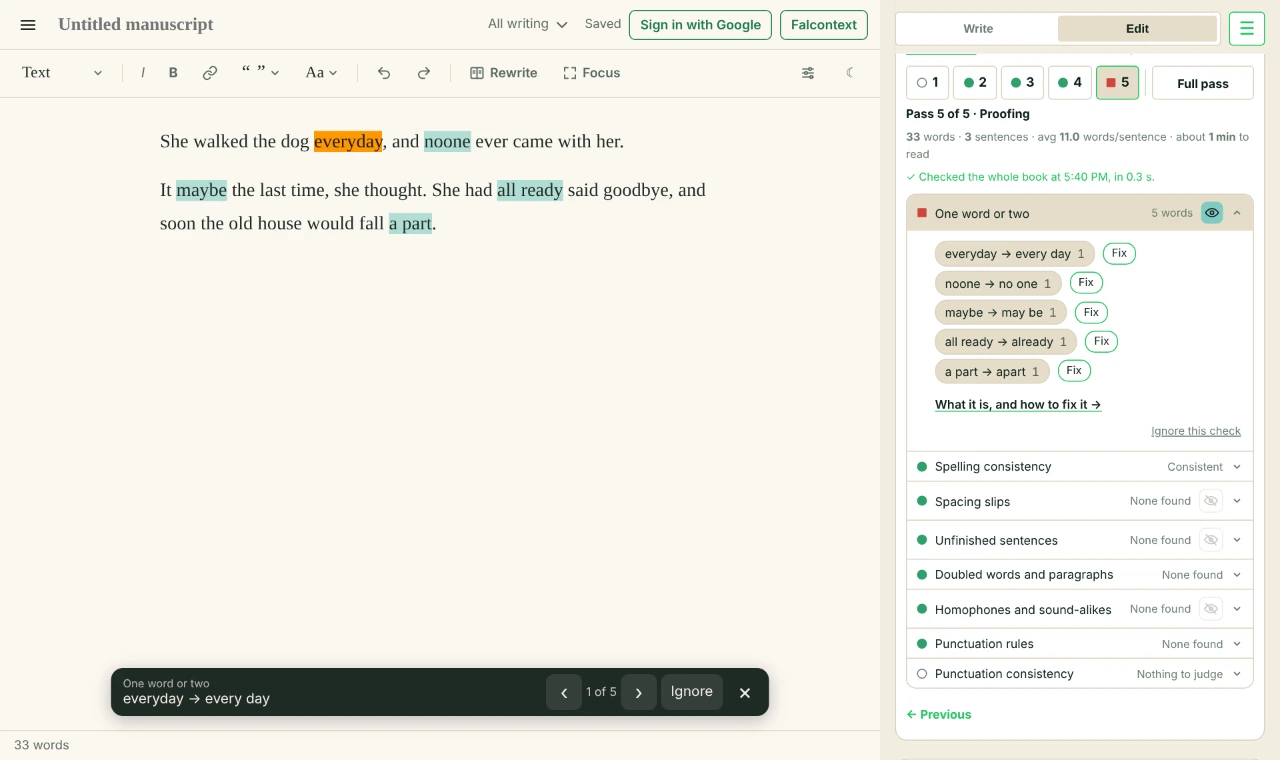
“I walk the dog everyday.” “It maybe true.” “She wanted to be apart of it.” One word where two were meant, or two where one was: your spell checker sees real words and stays quiet. Falcontext doesn’t.

New in Falcontext 6.0, in the browser extension, the desktop app and Perch.
Same letters, different meaning
Some words change meaning when the space goes. “Every day” is how often; “everyday” means ordinary. “May be” is a verb; “maybe” means perhaps. Both are spelled right, so only the words around them tell you which one the sentence needs.
What it finds
- Every day and everyday: “I walk everyday” (every day: each day), “my every day clothes” (everyday: ordinary). Also “everytime”, always two.
- May be and maybe: “It maybe true”, “There maybe a way” (may be), “May be we should go” (maybe).
- All ready and already: “I had all ready eaten” (already), “We were already to go” (all ready).
- All together and altogether: “a different thing all together” (altogether: wholly), “put them altogether” (all together: as a group).
- A part and apart: “to be apart of it” (a part of), “the house fell a part” (apart).
- Any way and anyway, some time and sometime, a while and awhile: “Is there anyway to stop it?”, “It took sometime”, “after awhile”.
- Every one and everyone, into and in to: “everyone of them” (every one), “walked in to the room” (into), “gave into temptation” (gave in to).
- Work out and workout, knock out and knockout: “I need to workout”, “it didn’t workout” (work out: the verb), “a good work out” (workout: the thing); “he’ll knockout the guard” (knock out), “won by knock out” (knockout).
- Words that are always two: alot, noone, eachother, infact, atleast, aswell, incase, inspite, infront, nevermind.
What it leaves alone
Only the clear cases are flagged. “Every day things got worse” could be read either way, so it stays. “Any more” for “no longer” is right in UK English, and “on to” and “onto” both are, so neither is flagged. “Came in to see her” and “turned him in to the police” are in, then to. “Any one else”, as books spelled it a hundred years ago, is left alone too.
Guidelines, not rules. Most of these will be real slips. Not all: a character’s own way of writing can look the same. You decide.
- Finds
- A word written as one where two were meant, or two where one was, each one marked in your text, with how it should be written.
- Traffic light
- None
- 1–2
- 3 or more
It’s also in the Write tab’s quick check of today’s words, with the other slips: doubled words, spacing, unfinished sentences and homophones.
These are read one by one in the guide’s proofing pass: they aren’t in Fix all, because each needs your eyes.
Questions about one word or two.
Is it every day or everyday?
Both, for different things. Every day is how often: I walk every day. Everyday describes a noun and means ordinary: everyday clothes, everyday life. If you can say “each day” instead, it’s two words.
Is it maybe or may be?
Maybe means perhaps: Maybe we should go. May be is a verb: It may be true. If you can put “might be” in its place, it’s two words.
Does the one word or two check use AI?
No. It uses rules written by hand, each one tested against published novels for what it should leave alone. Everything runs on your own device. Your writing is never sent anywhere, and no AI is used on your writing in any way.
Is it free?
One word or two is in Pro. Without it the light still goes orange or red when there’s a slip somewhere; Pro shows you where.
Related checks
In Falcontext
Your next chapter starts today.
Set a goal, open your draft and let the checks look over your shoulder.
Add to Chrome – it's freeOr get the desktop app or Perch, the web app.
Free forever plan · No sign-up · Pro from $1.99/month with a free trial