Prose checks › Continuity slips Pro
Prose check: continuity slipsWasn’t she already standing?
Each sentence is fine on its own, which is how these slips get past writers, editors and proofreaders. Falcontext keeps track of who’s standing, and what colour their eyes are.

Standing up twice
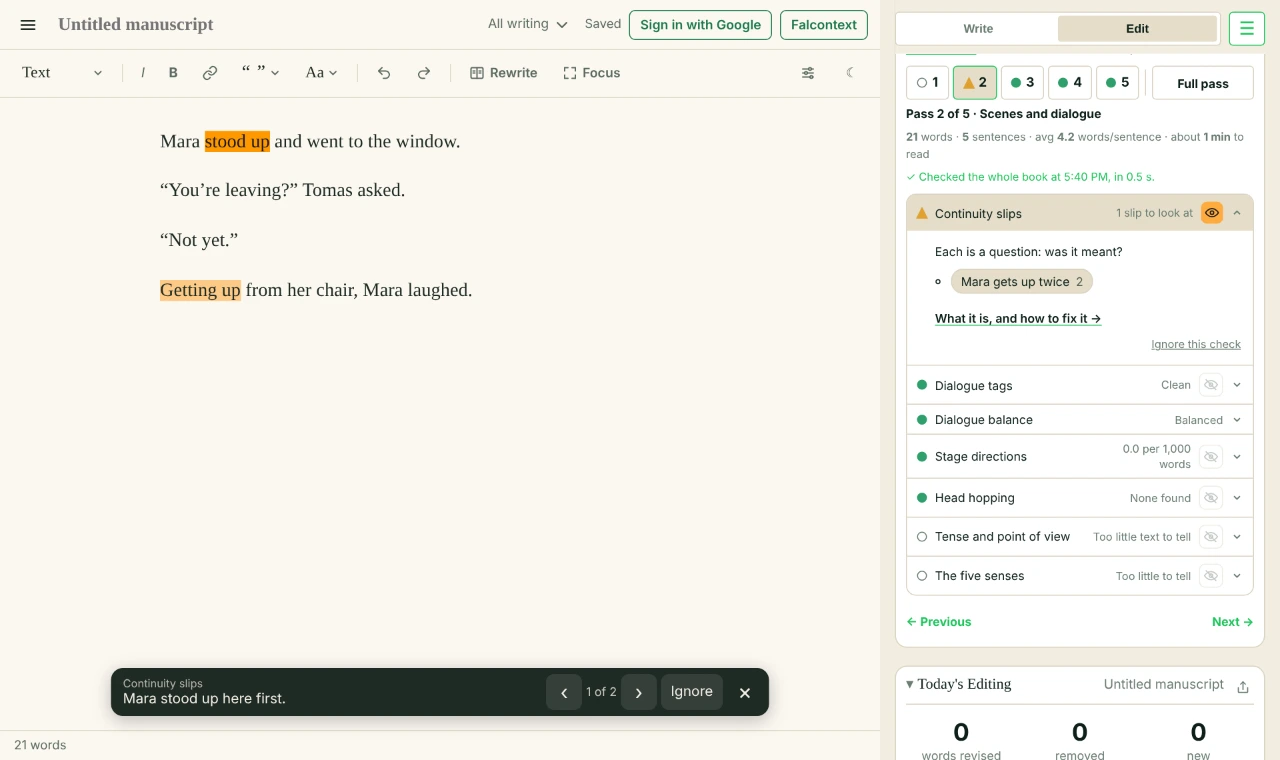
A character stands up, a few lines of dialogue go by, and then they get up again, without ever sitting down in between. Or they sit down while they’re already sitting.
“You’re leaving?” Tomas asked.
“Not yet.”
Getting up from her chair, Mara laughed.
“You’re leaving?” Tomas asked.
“Not yet.”
Turning from the window, Mara laughed.
Both are marked in your text: the first (“Mara stood up here first.”), then the slip, which says where the first one was: “Mara already stood up 2 lines earlier.”
Eyes that change colour
Green eyes in chapter 2, blue in chapter 19. Falcontext remembers what the book says about each character’s eyes, hair (colour and length), height and the hand they write with, across the whole book, and asks about the one that doesn’t match: “Mara’s eyes: green in ch. 2, blue in ch. 19. Was this meant to change?”
Close colours count as one: grey-blue and blue, dark brown and brown, blond and fair, auburn and red. Red eyes from crying, a face gone white or eyes blue with cold are moments, not features, and aren’t counted.
Only clear cases
Better to miss one than to ask about nothing. A slip is found only where it’s clear who it is: the name right there (“Mara stood up”, “Mara’s green eyes”), or a he or she when only one character of that kind is in the scene. Only the narration counts, never what characters say. Time passing (“an hour later”, “the next morning”), a scene break or a new chapter, and a flashback (“she had stood up”) all start over.
Hair gets dyed, cut and greys; beards get shaved. Words like those near a change keep it quiet, and anything else you meant, you ignore there.
A character sheet you didn’t have to keep
The same reading gives each character you track in Characters a short sheet: eyes, hair, build, marks, the rest, only as the book says them. Tap a value and Falcontext shows each place it’s written. A finding about someone’s eyes links to their sheet.
How Falcontext checks continuity slips
Guidelines, not rules. A change can be the story. Each finding is a question, never red.
- Finds
- A character getting up while already standing or sitting down while already sitting, within a few hundred words; and eyes, hair, height or hand that change across the book. Each marked in your text.
- Traffic light
- None
- Any
- Never red
- Plan
- Pro The check and the character sheets.
It’s one of the slips the Write tab checks while you draft, too.
Fixing a continuity slip can mean rewriting part of a scene, so the guide puts it in pass 2, scenes and dialogue: before you polish the scene’s sentences and words.
Ever had a character stand up twice in one scene?
Questions about continuity slips.
How do I find continuity errors in my novel?
Falcontext’s continuity slips check finds a character who gets up while already standing or sits while already sitting, and eyes, hair, height or the hand someone writes with that change from one place in the book to another.
What if the change is meant?
Ignore it there. Each finding is a question, never red: hair gets dyed and cut in stories. Words like dyed, cut or shaved near the change keep it quiet already.
Related checks
In Falcontext
Your next chapter starts today.
Set a goal, open your draft and let the checks look over your shoulder.
Add to Chrome – it's freeOr get the desktop app or Perch, the web app.
Free forever plan · No sign-up · Pro from $1.99/month with a free trial