Prose checks › The five senses Pro
Prose check: the five sensesWhat does it smell like?
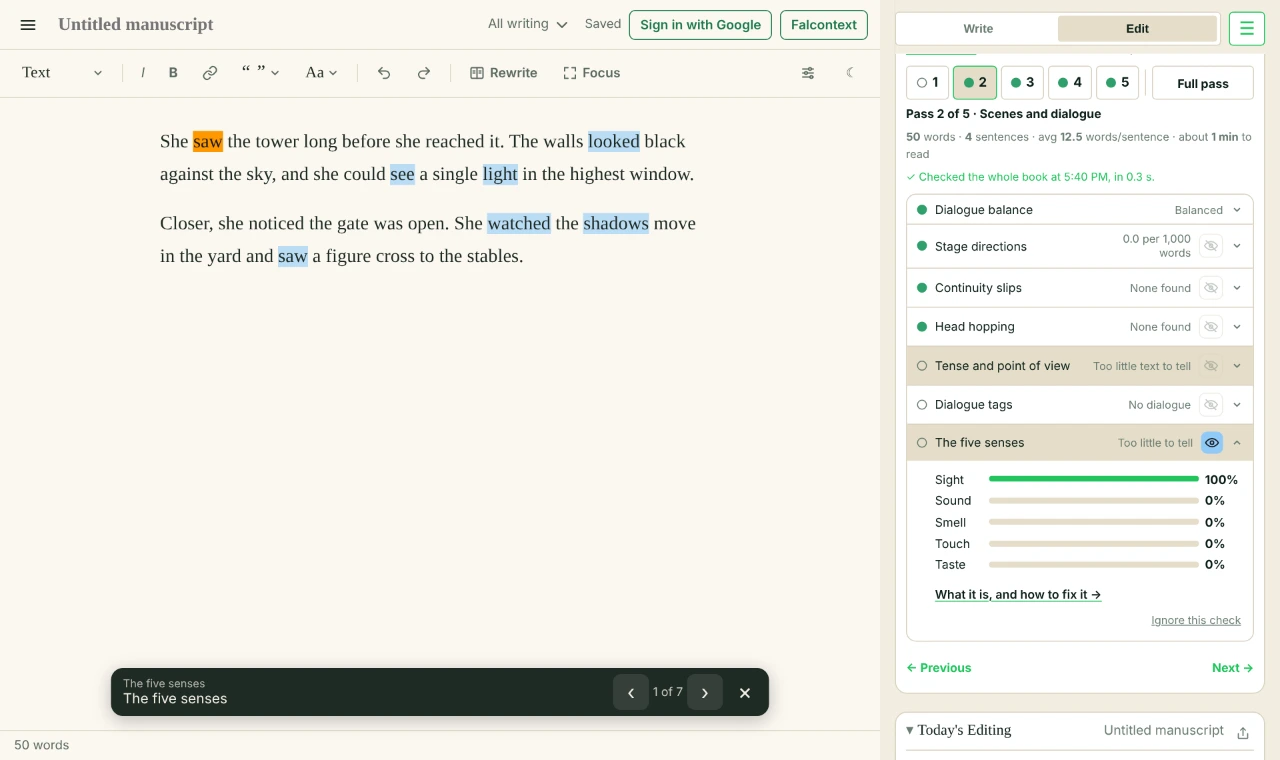
Most drafts are all eyes: she saw, it looked, the light. Falcontext counts how much the narration of your fiction draws on each of the five senses.

Why the five senses matter in fiction
Sight is the easy one. But a scene with a sound in it, a smell, the cold of a stone wall, feels like a place you’re standing in.
A book that leans only on sight can feel thin, even when every sentence is fine.
The five senses in published fiction
Sight still wins in published fiction. In the 38 books I measured, sight was 63% of the sense words in the middle book, and 73% at the most.
Where these numbers come from.
How Falcontext checks the five senses in fiction
Guidelines, not rules. A sight-heavy book isn’t wrong. It’s a nudge to look for the other four.
- Finds
- Words of seeing, hearing, smelling, touching and tasting in the narration, as a share for each sense. Dialogue isn’t counted.
- Traffic light
- 4 or more senses, sight 70% or less
- 3 or more, sight up to 80%
- Fewer, or more sight
Pick one scene and add one sense that isn’t sight. That’s usually enough.
The five senses come up in the second of the guide’s passes, scenes and dialogue: a scene that leans only on sight needs more than a word changed.
Which sense do you write least?
Questions about the five senses.
How do I use the five senses in my writing?
Find a scene that’s all sight and add one other sense: what it sounds like, smells like, feels like to the touch. Falcontext shows the balance across your book.
How much sight is too much?
In published fiction sight is usually about two thirds of the sense words. Falcontext goes orange above 70%, and red above 80%.
Related checks
In Falcontext
Your next chapter starts today.
Set a goal, open your draft and let the checks look over your shoulder.
Add to Chrome – it's freeOr get the desktop app or Perch, the web app.
Free forever plan · No sign-up · Pro from $1.99/month with a free trial