Help › Glossary Pro
GlossaryYour world’s own words.
The words your book made its own, with what they mean, kept with your manuscript and never counted as uncommon.
Words found
The Edit tab’s Glossary lists the words your book makes its own: an ordinary word it writes with a capital (Purity, the Vessel), a capitalised word shaped like a term (Emoting, Anointment), or one mostly used after “the” (the Conclave). Your characters and places are left out. A word’s forms are one word: Emoting (and Emoted). Tick the ones that belong in your glossary.
Rare words are words in small letters, used twice or more, that aren’t in Falcontext’s dictionary or among the 20,000 most used in fiction: your own, or real but very rare.
A meaning from your book
Writers explain a new word the first time they use it, and Falcontext looks for that: “…is what we call Emoting”, “a beautiful city named Hinan”, “the kethra, a shallow river boat,”, “the Vessel (the one who carries it)”. It shows the meaning with the sentence it came from. Accept it, change it or write your own: a meaning you accepted or wrote is never changed. Where your book doesn’t explain the word, it says No meaning yet.
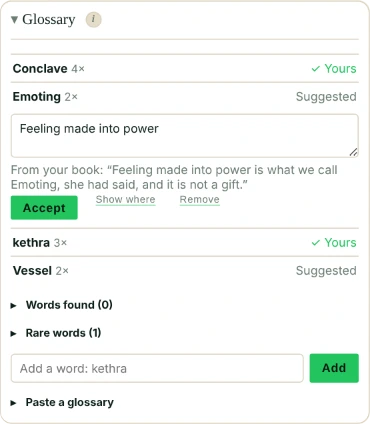
Before you write
Add a word yourself, or paste a whole list under Paste a glossary, one word a line with its meaning after a colon: kethra: a shallow river boat. A word not used yet says so.
Spelled another way
“kethrah (1×): did you mean kethra?” A word a letter off from one in your glossary is flagged; click it to see where. And words in your glossary are never counted as uncommon words.
- Plan
- Pro Part of Pro ($1.99/month or $19.99/year, with a free trial).
- Works in
- Falcontext 6.0 and later: the browser extension, the desktop app and Falcontext Perch.
- Kept
- With the document, and on your other devices with Drive sync.
Questions about the glossary.
Does Falcontext look meanings up online, or ask an AI?
No. A meaning only ever comes from your own book. Your writing is never sent anywhere, and no AI is used on your writing in any way.
Why are Emoting and Emoted one word?
They’re forms of one word. The one your book uses most names it, and every form counts as it, in the glossary and in Show where.
Related
Your next chapter starts today.
Set a goal, open your draft and let the checks look over your shoulder.
Open Falcontext PerchOr get the desktop app or the browser extension.
Free forever plan · No sign-up · Pro from $1.99/month with a free trial