Prose checks › Head hopping Pro
Prose check: head hoppingWhose head are we in?
A scene told from inside Anna slips into Mark’s thoughts for a line, and the reader loses their footing. Falcontext notices whose thoughts each scene tells, and where it switches.

One head per scene
Most novels today tell each scene from inside one character: we hear what they think, feel and remember, and see everyone else from the outside. Head hopping is when the scene slips into someone else’s thoughts without a break, often for just a sentence.
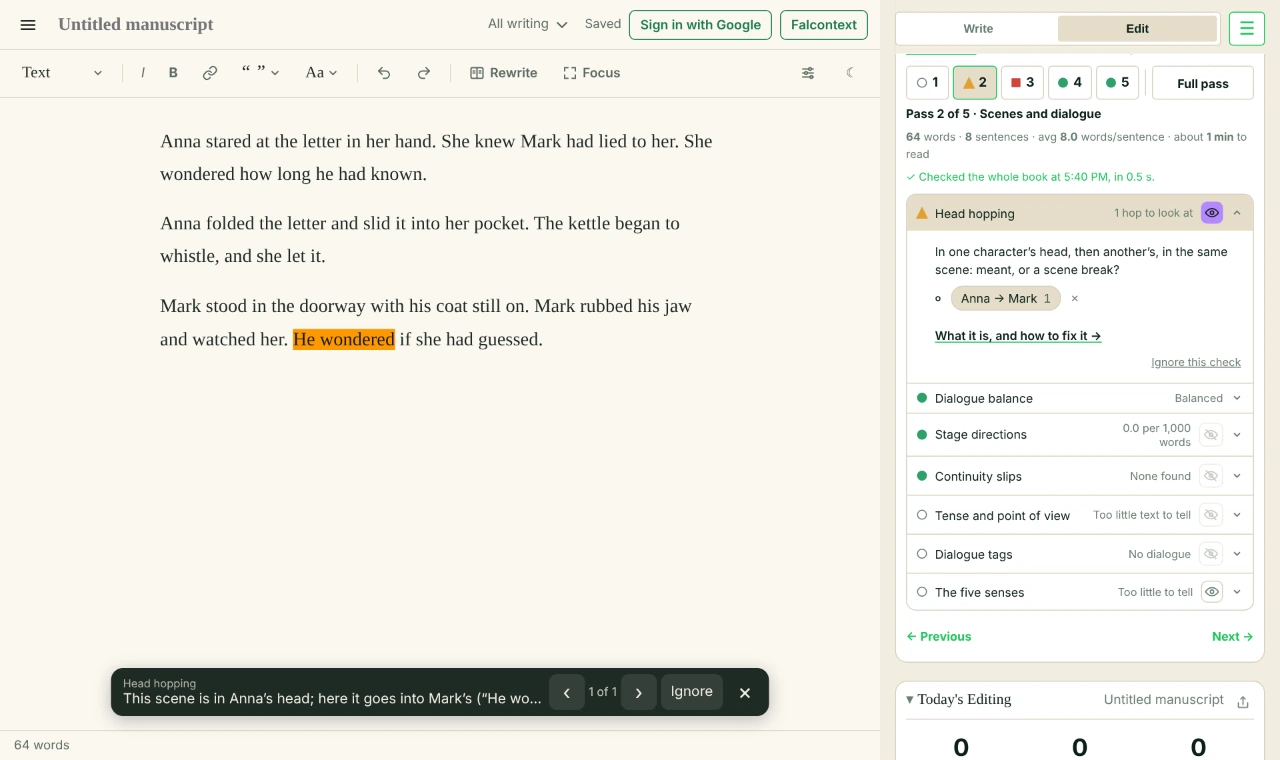
Mark watched her from the door. He wondered if she had guessed.
Mark watched her from the door, his jaw tight. Had he guessed she knew?
The finding says whose head the scene is in: “This scene is in Anna’s head; here it goes into Mark’s (‘He wondered’). One head per scene, or a scene break?” Show Mark from the outside, as Anna sees him, or give him his own scene.
What counts as being inside someone
What only the point-of-view character can be told doing: knowing, wondering, feeling, remembering, hoping, fearing, deciding (“Anna knew”, “she wondered”), and the body from inside (“her heart sank”, “his stomach churned”). The character told that way most often in a scene, at least twice, is whose head it’s in. Someone else told that way in the same scene is a possible hop. A scene ends at a scene break (a line of * * * or a blank line or two) or a new chapter.
In a book told in the first person, the narrator’s “I knew” is the head, and “Mark wondered” is a hop.
Only clear cases
Better to miss one than to accuse the wrong character. A hop is only found where it’s clear whose thought it is: the name right there (“Mark wondered”), or a he or she that can only be them, because they’re the only man or woman in the scene so far. Falcontext learns who’s a he or a she from your book; in Characters you can choose he, she or they for anyone it gets wrong. Only the narration counts, never what characters say. A thought about someone else’s thought stays the first one’s: in “She knew that Mark wondered”, the scene is still in her head. “Everybody in town knew” and “Heaven knows” aren’t anyone.
Nor is what someone else could be told. An opinion can be said out loud (“Hilm thought it was anything but a done deal”), and so can a fact a character knows (“Henry knew of a hotel there”); “She felt safe to him” is his feeling, not hers. These still show whose head a scene is in, but they’re never a hop. Nor is what anyone in the room could see: “Mark thought for a moment and shrugged”, “thought about it”. “Thought” counts as thinking when it says what (“thought of the money”, “thought about the letter”) or to himself.
One person under two names counts once: a name that’s the start of another, four letters or more (“Meri” for Merily), or a name you add under Also called on their sheet in Characters.
Two characters who share each other’s thoughts on purpose (a bond, telepathy): click the × by that pair once, and Falcontext leaves them out for the whole book.
Unless your narrator knows everything
An all-knowing (omniscient) narrator goes into every head on purpose: many older novels are told that way, such as Virginia Woolf’s Night and Day and D. H. Lawrence’s Sons and Lovers. That isn’t a mistake, so each finding is a question and the light is never red. When many scenes go into more than one head, the check says it may be an omniscient narrator and that you can leave the findings be.
The POV character of each part
The same reading puts the ★ in the Characters matrix: for each scene or chapter, its point-of-view (POV) character, the tracked character whose thoughts it tells. Where no one’s thoughts are told, the ★ goes to the one mentioned most, as a guess.
How Falcontext checks head hopping
Guidelines, not rules. Some books change heads on purpose. Each finding is a question, never red.
We tried it on 32 public-domain novels from 1900–1922 (the same books the lights are set from). Close third-person novels such as Ethan Frome and Babbitt got no findings. Books known for going into many heads, such as Woolf’s, Lawrence’s and Jack London’s, were told they may have an omniscient narrator. In three hand checks of 22 random findings each, 13 to 17 were really a second character’s thoughts in the same scene, about 7 in 10. Most of the rest: a character under a second name (“Miss Bart” for Lily), a child’s view of what grown-ups know, or a chapter heading the book didn’t mark as one.
- Finds
- A scene told from inside one character that goes into another’s thoughts, the first time for each in a scene. Each marked in your text.
- Traffic light
- None
- Any
- Never red
- Plan
- Pro The check and the POV ★ in Characters.
It’s in the second pass, Scenes and dialogue, with tense and point of view.
Point of view is the big picture of a scene, so head hopping comes up in the second pass of the self-editing guide: who’s telling each scene, then how the characters talk.
Whose head is your opening scene in?
Questions about head hopping.
What is head hopping?
Head hopping is when a scene told from inside one character’s head slips into another character’s thoughts, without a scene break: Anna wonders whether Mark lied, and a line later Mark wonders whether she guessed. Falcontext’s head hopping check finds where that happens in your novel.
Is head hopping always wrong?
No. An all-knowing (omniscient) narrator goes into every head on purpose, as Virginia Woolf and D. H. Lawrence did. Each finding is a question, never red, and when many scenes go into more than one head, Falcontext says it may be an omniscient narrator.
Related checks
In Falcontext
Your next chapter starts today.
Set a goal, open your draft and let the checks look over your shoulder.
Add to Chrome – it's freeOr get the desktop app or Perch, the web app.
Free forever plan · No sign-up · Pro from $1.99/month with a free trial