Let me be very clear upfront. Falcontext gives insight into where your draft or manuscript stands compared to other books. None of what it “recommends” is an actual rule. Like I always say: these are guidelines, not rules. If you chose this style willingly, then ignore away. That’s why Falcontext has had “ignore” as long as it’s had its prose analysis. It’s your book. Falcontext is just here to help.
Stephen King says the road to hell is paved with adverbs. Elmore Leonard told writers never to use a verb other than “said” to carry dialogue. George Orwell said never to use the passive where you can use the active. And every writing class says show, don’t tell.
I wanted to know how well published novels keep to these so-called “rules”, so I measured 109 of them, written between 1900 and 2013, with the same checks Falcontext runs on your draft. I also went looking for what researchers have found.
The short answer: the rules point in the right direction, but not one of the 109 follows them as rigidly as they’re put.
This is the first post in a series. Every Monday, Wednesday and Friday, I’ll take one of these rules on its own: who says it, what published novels actually do with it, and what research has found. This post is the overview.
Adverbs
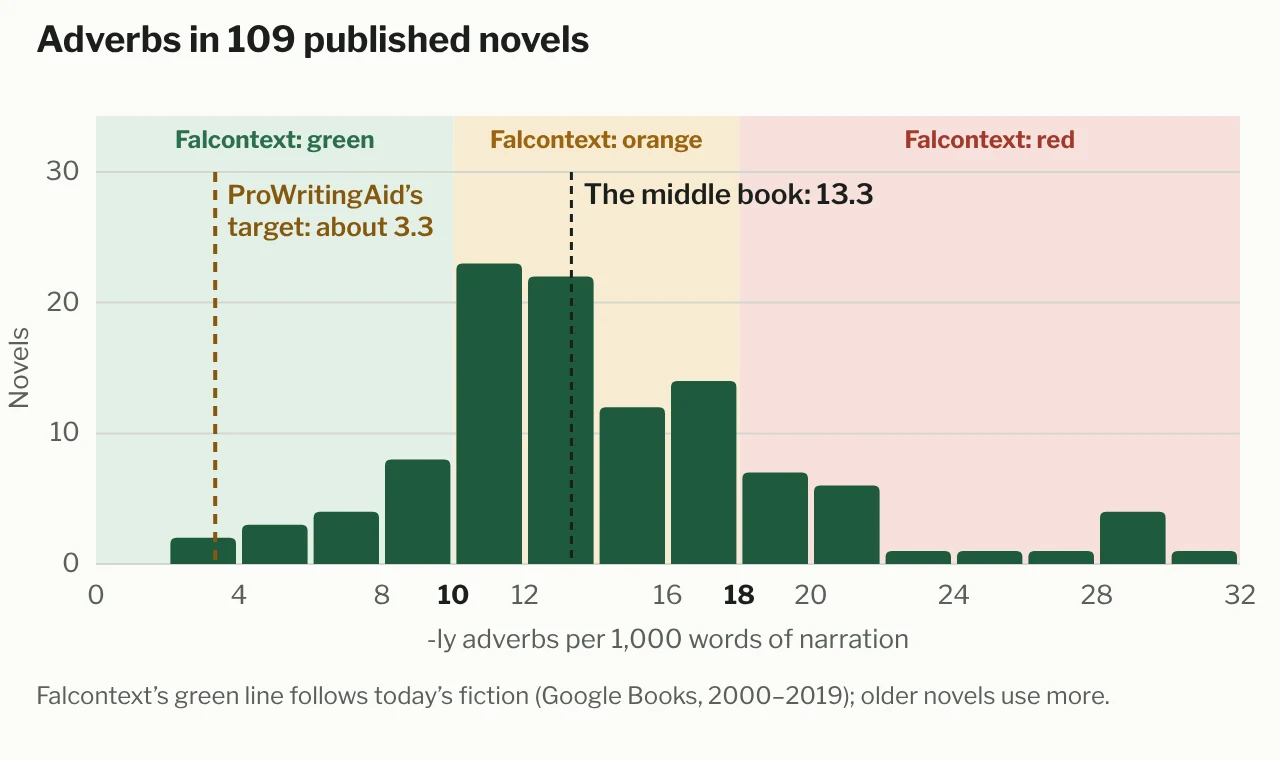
King’s line comes from On Writing, where he calls the adverb “not your friend”. It looks like writing tools agree. ProWritingAid aims for about one -ly adverb in every 300 words.
Published novels use a lot more than that. The middle (median) of my test of the 109 books has 13.3 -ly adverbs per 1,000 words of narration, or one in every 75 words, about four times ProWritingAid’s target. Half of the books fall between 10.6 and 16.6.
Ben Blatt found much the same for his book Nabokov’s Favorite Word Is Mauve (2017). The novels that reached number one on the New York Times list since 2000 averaged 11.5 -ly adverbs per 1,000 words, and the middle of the last 100 winners of major literary prizes had 11.4. Fan fiction came out higher, at 15.4 (his findings on Lit Hub). So published writers do use fewer adverbs than non-published authors, just nowhere near none.
Novels have also been using a few fewer over time. In the 82 novels from 1900 to 1930, the middle book has 13.8 per 1,000 words; in the 21 from 1983 to 2013, it’s 12.6 (those recent ones are the novels free to read, mostly science fiction and thrillers). Across all the English fiction in Google Books from 2000 to 2019, some 85 billion words of it, it’s 10.4. That’s where the green line of Falcontext’s adverbs check sits: up to 10 is what today’s fiction does, orange runs to 18, and only beyond that does it turn red.
“Said”
Leonard’s rules, written for the New York Times in 2001, go further: only “said”, and never “said” with an adverb attached.
The middle of the 109 books has nearly one dialogue tag in five breaking that rule: a verb fancier than “said”, an -ly adverb on the tag, or a gesture used as a tag, as in “Yes,” he nodded. Half of the books sit between one in ten and three in ten.
Here the change over time is big. In the novels from 1900 to 1930, the middle book flags about one tag in five (20%); in the 19 recent ones with enough dialogue to count, about one in fourteen (7%). Falcontext’s dialogue tags check stays green up to 18% of tags, and turns red past 34%.
A study of Harry Potter and the Philosopher’s Stone counted every reporting verb in the book: “said” made up 65% of them, and 18% came with an adverb (Bidasiuk and others, 2023). Readers do take those adverbs in, too. In an eye-tracking study, people read the same line faster when it was “said energetically” than when it was “said nonchalantly”, though the study didn’t compare either with a plain “said” (Stites, Luke and Christianson, 2013).
The passive voice
Orwell’s rule is from his 1946 essay “Politics and the English Language”. Novels mostly keep it: the middle book has 4.8 passives per 1,000 words of narration, so they’re there, but they’re rare. Recent novels use fewer still: 3.7 per 1,000 words, against 5.1 in the novels from 1900 to 1930. Falcontext’s passive voice check is green up to 5 and red past 7. English as a whole has been moving the same way. Written English used fewer passives in the early 1990s than in 1961 (Leech and others, 2009).
Show, don’t tell
Naming a feeling outright, as in “she was furious”, is what this rule warns against. The middle book of the 109 does it 3.5 times per 1,000 words of narration. Recent novels do it less: 2.1 times, against 3.8 in the novels from 1900 to 1930. Falcontext’s show, don’t tell check is green up to 5 and red past 8.5.
Novels have been moving towards showing for a long time. Across 2,958 British novels of the 1800s, abstract words of moral value became rarer while action verbs nearly tripled, a shift the researchers called “from telling to showing” (Heuser and Le-Khac, 2012). And emotion words in English fiction have slowly become less common over the past two hundred years (Morin and Acerbi, 2017).
Exclamation marks
Leonard allowed “no more than two or three per 100,000 words of prose”. Published novels use far more: the middle book has 0.6 per 1,000 words of narration, twenty to thirty times his limit. Recent novels use fewer: 0.4 per 1,000 words, against 0.7 in the novels from 1900 to 1930. Falcontext’s punctuation habits check is green up to 2 and red past 5. A few go much further, like Lady Chatterley’s Lover, at 5.9.
Shorter sentences
There’s no famous rule for this one, but novels have been moving towards it anyway. In about 9,000 novels from 1880 to 2000, sentences got shorter and the books easier to read, though, as the researchers put it, “not simpler” (Bizzoni and others, 2023).
Seeing, more than anything
“Use all five senses” turns out to be good advice, because novels mostly use one. In the middle book, 70% of the words for the senses are about seeing. Falcontext’s five senses check shows how yours compare.
So, should you follow the rules?
You should always do what you want. It’s your book. But all of what I’ve written here shows that these rules exist mainly because you should pay attention to how you use them. Don’t follow blindly. Just be aware, and decide whatever works best for you and your book.
That’s why Falcontext’s icons aren’t set by a rule. They come from what these books do: green is what most published novels do, and red is beyond nearly all of them. How the icons are set.
Next in the series, on Friday: is “said” really the only tag you need?