Falcontext › Guides › Keep track of characters
Writing guideKeep track of your characters.
How to keep track of characters when writing a book: what to note, the ways writers keep it, how long a character can be off the page in published novels, and the slips to check for before anyone else reads it.
On a phone or tablet? Falcontext Perch, the web app, works in any browser.
What to keep track of
A slip in any of these can pull a reader out of the story:
- The name, and every other name: how it’s spelled, nicknames, titles (“the captain”, “Mother”).
- Looks: eyes, hair, height, build, scars, the hand they write with.
- Age and dates: a birthday, how old they were when something happened.
- Family and ties: who’s whose sister, who owes whom.
- Where they are: which chapters and scenes they’re in, and where they were last seen.
- What they know: a secret one character can’t know yet.
- Point of view: whose head each scene is in.
- How they talk: the words only they use.
- Exits: who leaves, and who dies, and where.
Write each fact down the first time you put it on the page. Most slips come from a detail invented in chapter 2 and forgotten by chapter 19.
Five ways writers keep track of characters
1. A character list
One line per character: name, other names, role, the chapter they come in. Quick to keep, and enough for a small cast. Copyeditors keep the same thing on their style sheet, for the spellings.
2. A sheet per character
A page each, with looks, family, history and voice. Good for your main cast; most writers stop filling them in for the minor ones, which is where slips hide.
3. A spreadsheet
Columns for the facts, or a grid: a row per chapter, a column per character, a mark where they appear. The grid shows at a glance who’s been gone for half the book. A free character list to copy (CSV: opens in Google Sheets, Excel or Numbers), with columns for every fact above.
4. A story bible
Everything about the book in one document: characters, places, timeline, invented words. For a series, a series bible is close to essential: book four has to match book one.
5. Index cards or a wall
A card per character, moved around as the plot changes. Easy to see, hard to search.
All five have the same catch: you type every fact yourself, and the moment you rewrite a chapter, they fall behind the book.
Names that are easy to keep apart
- Give main characters different first letters and sounds: Jon and Jan blur, Jon and Petra don’t.
- Vary the length: one syllable, two, three.
- Keep a list of every name you’ve used, minor characters too, and check it before you name someone new.
- Choose one spelling and keep it. Spell checkers don’t know your characters, so “Rena” for “Reina” gets through.
How long can a character be off the page?
No study sets a number. Reading research does show that the further back a name was last read, the longer readers take to place it, and that a reminder helps. So I measured what published novels do: 132 main characters in 27 novels from 1900 to 1922, from one mention of their name to the next.
- The middle main character’s longest absence: 8,100 words (9% of the book).
- 3 in 4 main characters: never gone longer than 17,100 words.
- 9 in 10: 23,500 words or less.
- The lead (the most-named character) is hardly ever gone: the middle one’s longest absence is 3,300 words.
So after about 15,000 words, or a fifth of the book, a reader may need a reminder when a character comes back: a detail, a relationship, where we last saw them. Any mention counts, even when others only talk about them. A main character who leaves early and never returns stands out too: of the 132, only 1 was last seen in the book’s first half.
The slips to check for
- A name spelled two ways: Reina on most pages, Rena on one.
- Looks that change: green eyes in chapter 2, blue in chapter 19.
- Getting up twice: a character stands, a few lines of dialogue go by, and they get up again.
- Someone who vanishes: gone for a third of the book with no reason.
- A slip of point of view: a scene in Mara’s head that tells what Tomas thinks.
Each sentence is fine on its own, which is how these get past writers, editors and beta readers. My own published novel had one: a character who stood up twice.

Let the book keep track of characters
Falcontext reads your manuscript and keeps the list for you, on your own device:
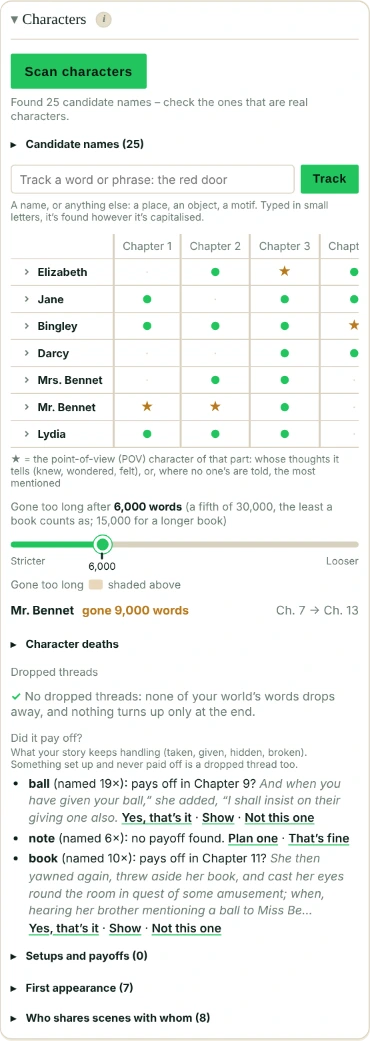
- Open your manuscript and click Scan characters under Characters.
- Falcontext lists the names that keep coming back. Tick the real characters.
- A grid shows who’s in each chapter and scene, and who’s been gone more than 15,000 words or a fifth of the book.
Track a place, an object or a motif the same way: type it in (“the red door”). Mark a character’s death and they’re no longer flagged as missing.
With Pro, click a name for their sheet: what they’re also called, their family, their looks as the book says them, where they first come in, and in the grid a ★ for whose point of view each part is told from. The name spelling, continuity and head hopping checks find the slips above, and the Field Guide gathers it all into a story bible to download for Word.
It works in the browser extension, the desktop app and Perch. Your writing is never sent anywhere, and no AI is used on your writing in any way.
How I measured
The 27 novels are public-domain books from 1900 to 1922, 32,000 to 167,000 words, from the books Falcontext’s checks are measured on, less story collections and books whose people are hardly ever named. For each, up to five main characters, not a first-person narrator or one who dies early. Every gap was counted with Falcontext’s own name matching and word count.
Questions about keeping track of characters
How do I keep track of characters in a novel?
Note each fact the first time you write it: names, looks, family, where they are. A list, a sheet per character, a spreadsheet or a story bible all work. Or let Falcontext find your cast in the manuscript.
How long can a character be gone?
In 27 published novels, 3 in 4 main characters were never gone longer than about 17,000 words. Past 15,000 words, or a fifth of the book, give readers a reminder when they return.
What is a story bible?
One document with everything about your book: characters, places, timeline and invented words. For a series it keeps later books true to earlier ones.
Is Falcontext’s character tracker free?
Yes, one character at a time. Pro tracks more, with each character’s sheet and the Field Guide.
Is my book sent anywhere?
No. Your writing is never sent anywhere, and no AI is used on your writing in any way.
Related
Meet your cast
Scan your draft and see who’s in each chapter.
Add to Chrome – it’s freeOr get the desktop app or Perch, the web app.
Free forever plan · No sign-up · Pro $19.99 a year, with a 14-day free trial